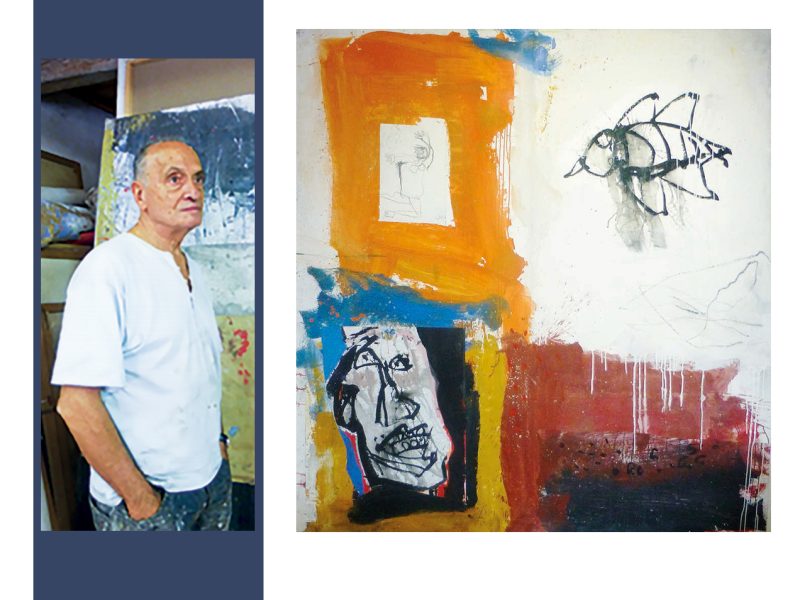
His neo expressionist and great-looking works of art are close to the expressive northern European language and run through intimate territories and complex transformations of the reality
VANNI SPAZZOLI’S WORKS ARE DREAM-LIKE PAINTINGS: labyrinthine lattices of lines criss-crossing to infinity, graphic signs in movement, holograms, radiographs of life and chromatic themes that become figurative-abstract plots. On the layering of texture recurrent patterns are mapped out: the consistency and minimalism of lines of colour on the canvas, the indefinite nature of shapes, the perfection of mathematics, animal forms. Born in Forlì in 1940, the artist discovered his vocation towards the end of the sixties, developing a solid figurative training, onto which he grafted a pictorial tension based on the value of matter and the gestural nature of the image. His first themes were still lifes, landscapes and figures, then, in subsequent years, he has dealt with the daily life subjects like locomotives, horses and horsemen, prams and children, caged birds, cats and more with individuals belonging to the unconscious sphere, like angels, christs, madonnas and musicians.
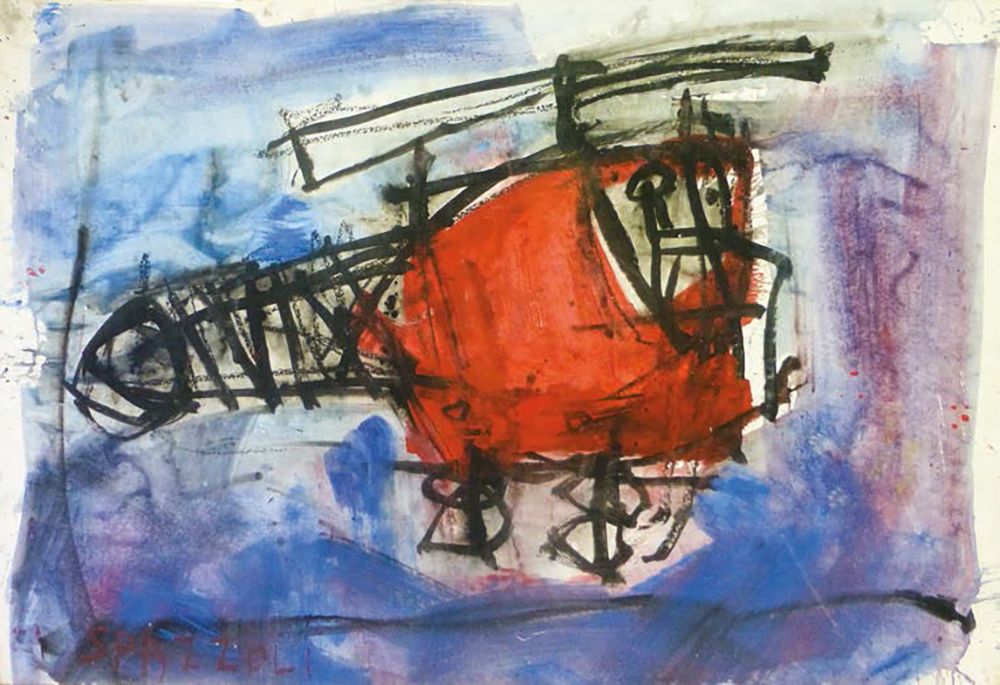
«The painted sign, wrote Adriano Baccilieri, «obeys profound impulses, sudden strong forces which are enraged and liberating, only to lapse into brush strokes that ooze downwards, without bothering to finish the animal figure, like the desperate movement of a hand that slides down the smooth, bare wall of the canvas, leaving the mark of its final attempt to cling onto something». On the surface the sign remains, a lacerated and lacerating gesture that commands the appearance of beasts from land or sea, or masculine-looking vehicles, shattered in the childish interpretation of shape. It is in isolation that Spazzoli finds the burning and radical motives for his catharsis through images, signs and colours. Consequently he is, today, a discovery, not a previous discovery or an imitator of the neo-expressionist climate of the eighties, but an isolated and secret identity operating in a quasi-clandestine regime, from which he is extracted. Claudio Spadoni wrote: «For Vanni Spazzoli, we could talk about a predominantly solitary journey, distant from what have turned out to be the guidelines of international artistic officialdom». It is all but inevitable to recall expressionism in the case of painting like this, which draws on a series of gestures often reminiscent of Action Painting, where the most accessible names appear to be Kooning and Kline».
(Vanni Spazzoli, Action Painting – Barchemagazine.com. – January 2016)