L’Italia Geniale – The Italian Genius

The italian pavilion at Expo 2020 in Dubai has opened the exhibition the italian genius. Design Enables – beauty, originality, creativity of a universally appreciated industrial design. The exhibition features an itinerary tracing the history of italian patents and industrial designs from the 1960s to today

by Barbara Borgonovo

What is the Aquarama by Riva, one of the world’s most beautiful and famous motorboats, doing in the same room with Alfonso Bialetti’s Moka coffee machine from 1950 and Algol di Brionvega’s radio? And what does Momo Design’s helmet have in common with Arduino, the famous and revolutionary hardware platform designed in 2005, or the 1948 Zenith stapler that we use every day in the office? Or again, how is Vico Magistretti’s timeless Atollo lamp related to Brembo’s avant-garde carbon ceramic braking system from 2002 and Vibram’s contemporary Furoshiki The Wrapping footwear? It sounds like an ill-assorted list. But it isn’t. It’s all right here – in this kaleidoscopic and varied universe – the Italian genius on display at Expo 2020 in Dubai.

The Italian Genius exhibition is organised by ADI and the ADI Design Museum for the Italian Ministry of Economic Development, the Italian Ministry of Foreign Affairs and International Cooperation and the General Commissioner’s Office for Expo 2020 Dubai, in collaboration with the Italian Patent and Trademark Office, Unioncamere and ITA/ICE Italian Trade Agency.

The exhibition The Italian Genius. Design enables has been conceived as a journey back in time through the history of patents and industrial designs filed with the Italian Patent and Trademark Office of the Ministry for Economic Development from the 1960s to the present day. Almost one hundred objects and designs were chosen, many of which were exhibited in Dubai and are included in the exhibition’s extensive catalogue. It is worth telling their story due to their value, in Dubai as elsewhere, in a universal space and time which belongs to the sphere of art.

INVISIBILE
An invisible sandal, as its name suggests, designed by Salvatore Ferragamo in 1947. A shoe created by observing the lines of fishermen along the banks of the river Arno, in the designer’s beloved Tuscany. A single thin thread of transparent nylon twists several times under the upper to form a delicate mask wrapping around the foot. The illusion is that of wearing an impalpable shoe to which the foot adheres by magic. The nine-centimetre sculptural F-shaped wedge in wood makes it a true masterpiece. It was awarded the Neiman Marcus Award, i.e. the Oscarof fashion.

Until 1930, Dubai was a place for pearl collection. Today, people ski in shopping centres. The desert is moving further and further away as the UAE launches a probe into the orbit of Mars. But in one of the biggest powers of the Persian Gulf, there is also room for the green, fintech and digital industries. The fourth most visited destination in the world after New York, London and Paris, Dubai is now home to more than three million people. In the post-war period there were just over twenty thousand.

«THE CORE OF ALL THE DESIGN OBJECTS CHOSEN FOR THIS EXHIBITION IS AND ALWAYS WILL BE MAN, WITH HIS NEEDS AND DREAMS, BUT ALSO HIGHLY TOPICAL ASPECTS SUCH AS SUSTAINABILITY AND INCLUSIVENESS HAVE BEEN AN INTEGRAL PART OF MADE-IN-ITALY DESIGN SINCE ITS OUTSET».
LUCIANO GALIMBERTI, PRESIDENT OF ADI

ATOLLO
Designed in 1977, Atollo is one of the masterpieces of the great designer Vico Magistretti (for Oluce Italia), who in the 1970s revolutionised the scene of domestic items for the upper middle-class home. Below, a dome that revisits the classic fabric lampshade in an abstract and exact way. Above, the stem transformed into a column that maintains stability. In the interplay of light and shadow generated by the interaction between the two elements, the dome seems to float in the void.

It is no coincidence then that the claim of Expo 2020 (which was postponed for more than a year because of the pandemic) goes straight to the point: Change the way you see the world. A slogan that seems to be made-to-measure to describe what is known around the globe as “Italian genius”. The genius that has been changing the way we see the world for centuries by creating beauty.

GHOST CHAIR
In 1987, designer Cini Boeri designed a chair, which would tell the story of an entire era. The invisible armchair was presented at the Salone del Mobile and is now on display at the Moma. Made of a single 12-mm thick sheet of glass and modelled with a thermoformed fold, Ghost is a true object-manifesto of the 1980s. Abstract and impalpable but at the same time solid, resistant and comfortable, the Ghost Chair was developed in collaboration with Tomu Katayanagi, Vittorio Livi and Fiam’s technical know-how in glass design and processing.

The Italy of excellence and design has been making its way to Dubai for some years now. No longer a destination for unbridled luxury, but increasingly within reach even for the middle class, Dubai is no longer just about entertainment and shopping, but is becoming a major cultural hub. Galleries, boutiques, ateliers, avant-garde tailor shops, collaborations with major museums, Arab-Western fusion restaurants: everything points to the city’s desire to intercept a cultured and sophisticated market.

AQUARAMA
Aquarama is the motorboat with a capital M, a symbol of exclusivity. With its timeless elegance, designed by engineer Carlo Riva in 1962, it has become a symbol of Italian style and class, crossing fashions and cultures. Produced for over thirty years until 1996, Aquarama has secured its place in the Olympus of the sea not only due to its outer beauty, but also for its structural features: a rigorous mass production process allows for complete control of all the components, while the level of finish is guaranteed by expert craftsmanship.

The exhibition illustrates Italian creativity not only with design objects but also with revolutionary inventions that have had and continue to have a decisive impact on our lives, as well as cutting-edge technological innovations. Home, office, leisure time, sports: Made in Italy has shaped all areas of our daily lives, in both mass consumption and niche markets, combining beauty and functionality in a unique way and generating employment and wealth.

ITALIAN GENIUS. DESIGN ENABLES. THE BEAUTY, ORIGINALITY, CREATIVITY OF THE UNIVERSALLY APPRECIATED INDUSTRIAL DESIGN. THIS IS THE TITLE
OF THE EXHIBITION HOSTED BY THE ITALIAN PAVILION FOR EXPO 2020 DUBAI.

An interesting aspect is the division into five macro areas whose titles use the ending “able”, as does the title of the exhibition, i.e. “capable of” and therefore possible. Five areas that brilliantly convey all the complexity of Italian design, organised in evocative giant transparent showcases designed by Studiomartino.5 from Rome.

Italia Geniale Expo 2022 Dubai

First comes the Imaginable section. That is, materials and products dedicated to games, fantasy, and the right to imagination in all phases of life – ironic, subversive and iconic objects. Such as the polyurethane monkey Zizì sprung from the encounter in 1952 between Bruno Munari and Pigomma (Pirelli), or Conico, the kettle designed by Aldo Rossi in 1986, as well as the famous Proust armchair by Alessandro Mendini, and the more recent W-Eye project by Matteo Ragni, which produces wooden eyeglasses, or the Orange Fiber by Adriana Santanocito and Enrica Arena, who in 2014 created a sustainable, organic fabric from the waste produced in the large-scale production of citrus fruit juices.

EV15 ICUB
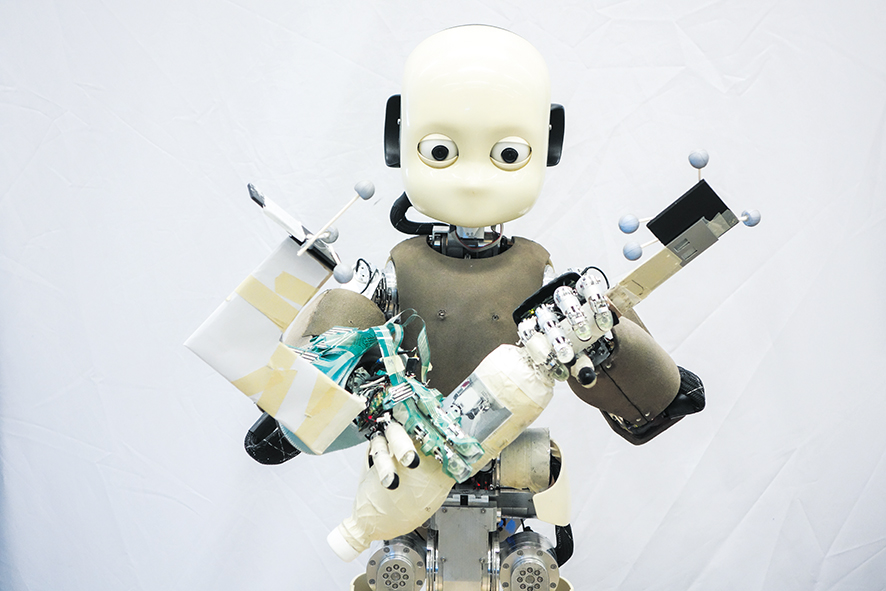
An android robot built in 2015 by the Italian Institute of Technology in Genoa and developed with the RobotCub Consortium. Standing 104 centimetres tall and weighing 22 kilos, iCub looks like a child of about three years of age. The artificial skin can interact with the world thanks to a human-like touch sensitivity and grip. The project is totally open-source both in terms of software, which is free and unencrypted, and hardware.

The Workable section contains all the objects that have changed the way we work. From Olivetti’s nomadic typewriter Valentine, designed by Sottsass, to the Tolomeo lamp with extendable arm produced by Artemide, to desk accessories like the Zenith stapler or the Coccoina glue designed by Aldo Balma in 1951. But there are also examples of artificial intelligence, the georadar designed by Opera duo and the Xfab 2000 3D printer.

The Workable section contains all the objects that have changed the way we work.

Relationable is the section dedicated to the relationship between people, between people and objects, and between objects and space. Italian design has radically changed relationships, rituals and gestures. Think of Bialetti’s Moka coffee maker, which for the first time in the 1930s allowed people to enjoy espresso coffee in their own homes. And then there is Lavazza’s ISSpresso, the coffee machine made in 2014 for the International Space Station that can operate in conditions of microgravity. Furthermore, the informal Sacco chairs for Zanotta and Le Bambole by Mario Bellini for B&B Italia, which revolutionised the way of sitting on upholstered furniture between the 1960s and 1970s. Other iconic pieces are the glorious Campari Soda bottle designed by Fortunato Depero as well as the reusable Nutella jar.

Vanity by Poltrona Frau.

The Proust armchair by Magis. Material: rotomoulded polyethylene. Suitable for outdoors.

And then, Liveable. In other words, images, materials and artefacts of Italian design conceived for the individual and collective activities of everyday life, from sports to health to the care for people and the environment. These range from the dental workstation Isotron, designed by studio Giugiaro, to Angelo Ricchiuti’s professional diving mask, from Technogym’s Skillmill treadmill to the futuristic artificial hand Hannes derived from robotics designed in 2019 by the Italian Institute of Technology.

Bombo by Magis, 1997. Swivel stool adjustable in height with gas piston. Materials: base in chromed steel, seat in standard injection-molded ABS.

Finally, Moveable, movement and sport. From the Vespa to Riva’s Aquarama motorboat, to Alfa Romeo’s 1966 Spider Duetto, from the super-light Aria 1.0 wheelchair for the disabled from 2013 in magnesium alloy and carbon fibre to the 2018 Ferrari Monza SP1. But there is also the six-legged dog, Eni’s logo designed in 1952 by sculptor Luigi Broggini, and the creasable, waterproof maps by Palomar, as well as Enel X’s JuicePole for recharging electric cars and vehicles.

The electric Fiat 500 car.

The Ferrari Monza supercar.

«The economy of beauty, the beauty of culture, beauty applied to work and manufacturing, which produces not only economic results, but also reputation and credibility». Paolo Glisenti, Italian General Commissioner for Expo 2020 Dubai.

A closet full of imagination, genius, and creativity. But also full of beauty, details, authentic lives, the lives of the designers who have designed these revolutionary objects, and the lives of those who have used these inventions and still use them every day. A talking, living museum, which has been temporarily immortalised in the great monumental closet in Dubai but which is destined to live on in the folds of our lives, day after day, like the enchanted objects in the Museum of Innocence created by Nobel Prize winner for Literature Orhan Pamuk for his friend Kemal. A museum that Kemal dedicated to his beloved Füsun, where the boundaries between reality and imagination are strongly blurred. As blurred as in the objects in Dubai that convey the Italian genius that has created and continues to create other worlds, always pushing the boundaries of the possible a little further, just like the city of Dubai, which year after year pushes the desert further and further forward.


(L’Italia Geniale – The Italian Genius – Barchemagazine.com – February 2022)