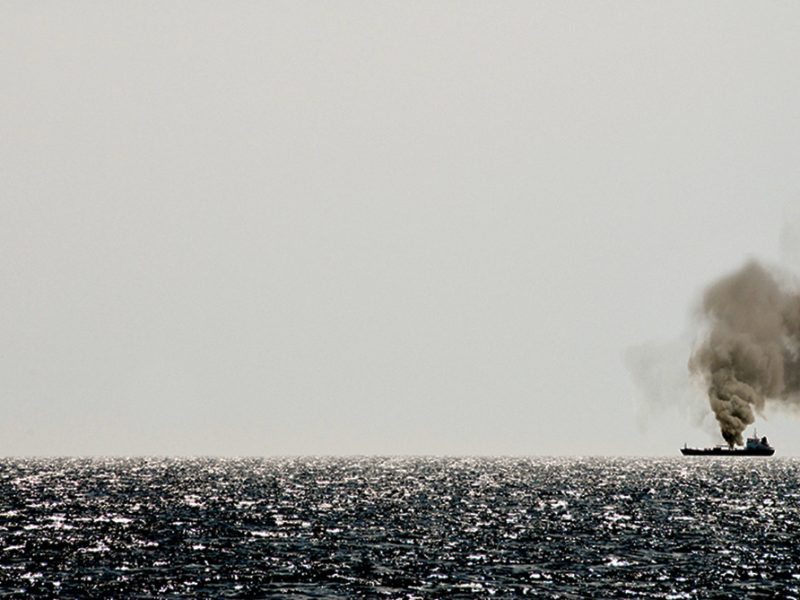
The new standards on reducing emissions for yachts over 24 meters long came into force in January, but not all shipyards and engine producers are ready. Paolo Bertetti from Sanlorenzo gives us his opinion and makes a suggestion
AS ALREADY EXPLORED IN THE MAY 2020 EDITION OF BARCHE, the IMO NOx Tier III standards set by the International Maritime Organisation (IMO) came into force in January 2021. The rules apply to shipyards building yachts over 24 meters long and with a gross tonnage of over 500 GT and require them to reduce their emissions of nitrogen oxides (NOx) by installing an SCR catalytic converter in the engine room of every boat.

The size and weight of the SCR system are negligible compared to the displacement and internal volume of a large commercial vessel.
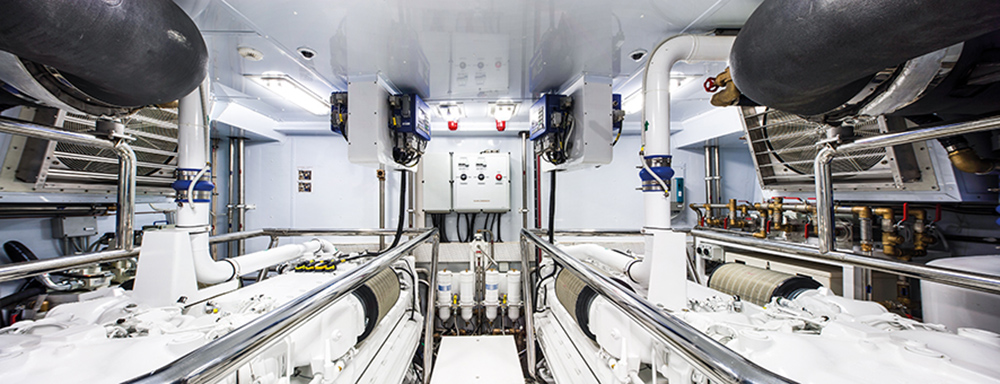
But the issue is space, and the fact that there are very few engines that are currently certified for this purpose, especially for 24 – and 35-meter yachts. The firms that build the engines focused first on producing models for larger ships, where adding the SCR catalytic converter is not a big problem – finding a solution for smaller engines is much more challenging. Furthermore, pleasure boating is not the manufacturers’ main priority, so it is no surprise that there has been limited investment in finding a solution. As things stand, engines with SCR catalytic converters have been tested in the factory, but, as we know, a lot of work is often needed before a new component can be installed in the engine room.
We asked Paolo Bertetti from Sanlorenzo for his opinion: «Basically, there is a finite amount of space in an engine room. You can’t overrule the laws of chemistry, and a chemical reaction needs a certain amount of space.
Catalytic converters work well when the exhaust fumes reach a high temperature, as happens on cruise ships, freighters, and ferries, where there is no shortage of space, and where the engines are usually on for many hours at high speeds. Pleasure yachts, meanwhile, have an average pace of between 10 and 14 knots and have much lower engine hours.

We know from the control panels of our yachts that the engines run for between 100 and 400 hours per year, much less than a cargo ship that sets off from China and travels at 19 knots to La Spezia, for instance. Small displacement boats, which do not sail much more, and certainly don’t travel at high speeds, are in a similar position».

The weight of an SCR system on a 100-foot yacht equates to 3-4 percent of the total displacement, with significant effects on fuel consumption.
The lack of space and the type of use are therefore not conducive to catalytic converter running efficiently. The rules came into effect in January 2021, and state that the engine of every yacht longer than 24 meters and above 500 GT with a keel-laid date in 2021 must have a catalytic converter. If construction began in 2020, you can install any type of engine. The problem with these regulations is that they were created around ten years ago and were designed for cargo ships, without considering the individual needs of yachts.


A bit like trying to install the catalytic converter from a lorry on a small car. «The automotive sector took a long time to find an effective solution too. Going straight to mass production without in-depth onboard testing of these new engines, it might mean facing the problems directly on the finished yachts», Bertetti says. He sounds somewhat worried because the boat owners and shipyard would be the ones to suffer. The problem is that it will not be possible to build certain yachts because of the lack of suitable engines. This is not good news – shipyards are already dealing with the economic fallout of COVID-19, and the last thing they need is another burden to deal with, such as not being able to build yachts between 24 and 35 meters long.

Let’s hope, then, that the International Maritime Organisation delays the date the rules are introduced. Just a year or two would suffice. Bertetti thinks that other solutions should be considered as well as a delay: «At the moment, the only solution offered is installing an SCR catalytic converter, but a hybrid motor would also help to reduce emissions. We also need to look at when emissions need to be reduced – definitely when boats are near the coast, and therefore near people, but converters are less efficient in these conditions due to the low temperatures of the exhaust fumes. And we shouldn’t forget that catalytic converters are bulky and heavy, which risks increasing fuel consumption and therefore emissions too. A hybrid motor that runs on electric power when near the coast would not have any of these problems».

In conclusion, it seems the IMO NOx Tier III standards work well for freighters, but are difficult to apply for yachts in their current format. It does not make sense to reject them entirely, because pleasure boating needs to reduce its emissions too. However, a little more time is needed to find the ideal solution, otherwise, we risk introducing a rule that contradicts its original aim.
(Emission Regulations, a great burden – Barchemagazine.com – February 2021)