The Rahmi M.Koç museum is an example of great passion for boating and its history. It belongs to a family with a close relationship with the sea and boats, as shown by the young heir, Ipek Kiraç, who is successfully running the Sirena Marine shipyard
by Bruno Cianci – photo by Bruno Cianci and Ali Konyali
For centuries Istanbul had the mysterious power of enchanting all those passing through it: merchants, diplomats, archaeologists, men of literature, hunters of all kind of emotions. Because of this rich history, the city on the Bosporus provides today many reasons why one should visit it. Thanks to a private collection of over 13500 pieces – that of Rahmi M. Koc, captain, entrepreneur and philanthropist – even those who are passionate of history of transports do have a place to visit on these shores: the Rahmi M. Koc museum (it is not unusual in Turkey to call museums, boats and infrastructures after the name of their founders). Rahmi M. Koc, leader of a company with a yearly turnover of over 21 billion and lover of all that is beautiful, recalls the origins of the museum with these words:«When I was a child, my father Vehbi gave me a little electric train toy from Germany as a gift; this is how I developed, in a spontaneous way, a passion for electric toys and industrial objects and this is how the collection began. With time, such passion developed, both in terms of dimensions and numbers of pieces, to the point that my houses, offices and warehouses became insufficient to host steam engines, models, scientific tools, boats, cars, antiques and modern objects. It then happened that after a visit at the Ford museum in Dearborn, Michigan, I understood what I should have done: gathering all my objects under one big roof».
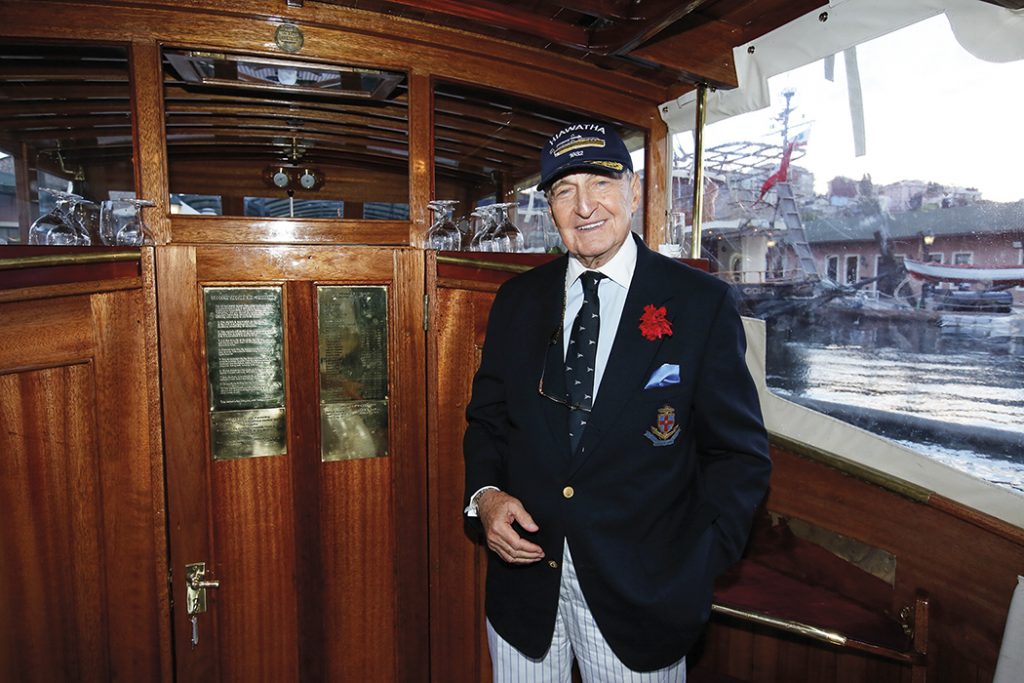
Rahmi M. Koç
The Rahmi M. Koc museum is in Hasköy, on the northern shore of the Golden Horn, the deep cove of the Bosporus which separates the oldest part of Istanbul from Galata, the historic Genoese neighbourhood. Founded twenty-three years ago (1994) and made bigger in 2001, the museum has an area of 27000 square metres (of which 11000 are indoors). To make a comparison, its area is not far from that of St Peters Square in Rome.
The museum is divided into two main areas, one called Lengerhane (the Anchors’ House) while the other is the Tersane (Shipyard). The first is a byzantine building from the 12th century, almost certainly a church, that was used during the Ottoman time as a foundry for anchors and chains of the Turkish fleet. In the very welcoming atmosphere of this solid building made with stones, thousands of artefacts, optical and scientific tools are hosted: among these an astrolabe from 13th century stands out together with steam machines, toys, electric trains, a de Havilland ‘vampire’ jet, dioramas and much more. The hulls and naval models’ collection is just astonishing, they all are in perfect conditions and they are wonderfully displayed in tailored wooden or glass cases. Since 1861 the Tersane has hosted the Şirket-i Hayriye shipyard, the Bosporus and Golden Horn ottoman steamboat company. This spectacular part of the museum has a characteristic horseshoe shape, with a basin and a slipway with an electric capstan in the middle. The dimensions of the displayed objects vary from the few centimetres of a razor that belonged to Kemal Atatürk (the father of modern Turkey) to that of the Uluçalireis submarine which is the biggest object of the exhibition. This is a giant of 94 metres, built in 1944 for the US Navy with the name of USS Thornback. It is twice as big as the Toti, which is exhibited in Milan.
Being Mr Koc a tycoon of the automotive sector (he builds and supplies Fiat and Ford cars in Turkey), the museum provides a remarkable collection of road vehicles: cars and commercial vintage vehicles (roughly eighty in total) are the main attraction, but even those passionate for motorcycles, carriages, trains and planes are not left without interesting pieces to appreciate both in the museum and its outdoor area. In the rail pavilion, Italian visitors usually gets attracted by an original Fiat Littorina, perfectly restored and evoking Italian songs from the 30s such as ‘Mille lire al mese’ and other songs that were popular at the time of its construction and that were listened to during the many journeys between Paola and Cosenza.
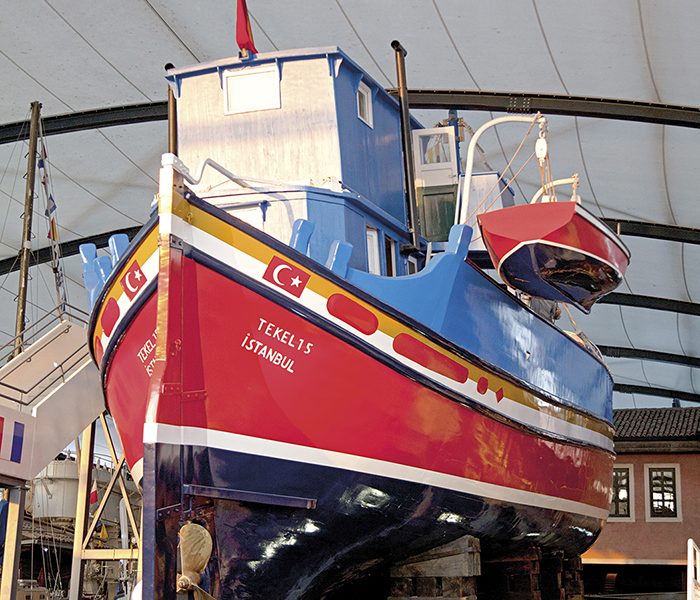
But the real added value of the museum is the nautical section. There are many commercial and leisure boats on display and also hundreds of nautical antiques. The Fenerbahce steamboat is the second biggest piece on display. It hosts a coffee bar and also the entrance for the guided tours at the Uluçalireis submarine, named after the Calabrian admiral Uccialì. Not far from this are the Gonca shuttle (1905), the Hiawatha commuter (1932), the ex-fishing boat Kont Ostrorog (1950) and three tug boats, among which the Vernicos Irini (1940) and the Dutch Rosalie (1873). On weekends it is possible to set sail and travel the Golden Horn on board of the Rosalie while during the week other boats offer the same service. In the area surrounding the ex-basin of the shipyard many leisure and work boats are also on display, among these the Ysolt steamboat, from 1893, a lifeboat ‘Classe Liverpool’, some yachts, the boats of the first two Turkish sailors who circumnavigated the globe in the 60s and 70s and, on the ramp, a wooden cargo ship with the classic round lines of the çektirme from the Black Sea. At the foot of the ramp lies the Clodia, a small Ness-yawl belonging to the Italian environmentalist Giacomo De Stefano who sailed and rowed from London to Istanbul in 2012 and from whom the museum temporarily borrowed the boat.
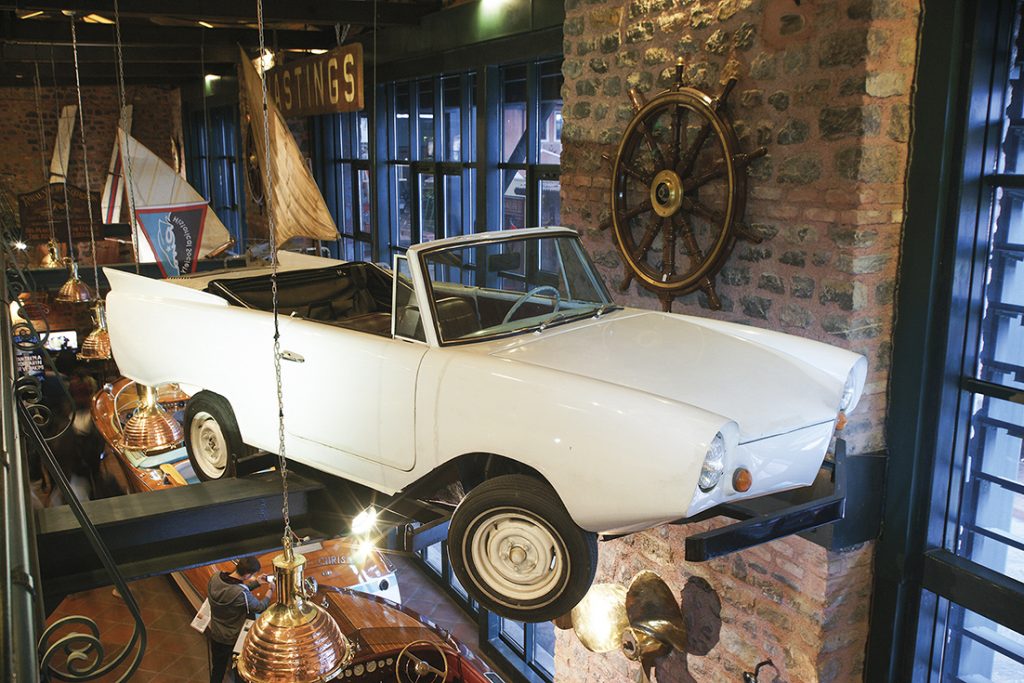
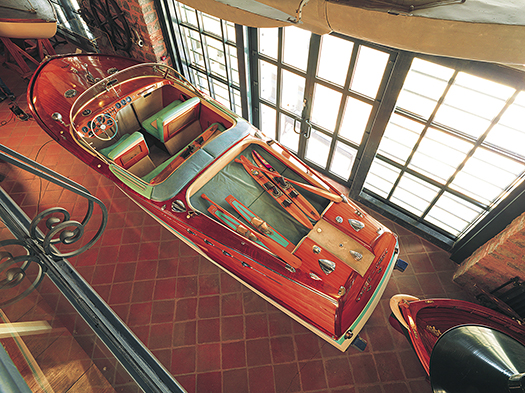
In the northwest area of the museum there is also an indoor nautical pavilion with thirty local rowboats (kayik), some canoes, the English cutter Swell (1910) and some runabout boats such as a Chris-Craft and three Riva, a Super Aquarama, an Olympic and a Florida. At the upper floor the collection of over fifty old outboard motors, built between the 20s and the 70s, is just astonishing and some of them are still functioning.
The museum keeps expanding and in a few years’ time there will be no more space – thing that actually has happened cyclically so far. And it is precisely the passion of his founder for the sea to bring new pieces to the museum. Maid of Honour, a speed boat belonging to the equipment of the battleship HMS Hood, plunged by the Bismarck and Prinz Eugen in 1941, is currently under reconstruction at the Tasdelen workshop. Another historic boat, the cutter Vilia(1910), is now at the RMK Marine shipyard in Tuzla (also belonging to Mr Koç and the place where his ketch Nazenin IV was built) waiting to be delivered to the museum in 2017. The increasing popularity of this place and the noble intention of opening such a big collection to the public left a very positive impression on many. It is not by chance that more and more institutions and private collectors lend or offer objects to be displayed. This is how unique pieces often gets added to those purchased by Rahmi M. Koç himself. He is the tycoon who wants to be remembered for his taste of beauty.
Tribute to Carlo Riva
«I learnt with sorrow and deep feeling of the demise of the legendary Carlo Riva. The way this gentleman managed to make his boats popular, whether in Italy, France or in the rest of the world, is just extraordinary. His boats have always been of excellent quality; boasting very reliable hulls and a unique design. Their manoeuvrability, comfort and the fact they have always been considered as status symbol also made them legendary. Many of the world celebrities loving sea, beauty and speed have owned, at least once in their lives, a Riva runabout. It would be desirable to still have boats like these, but new materials, technologies and the market demands have limited the survival of these boats only to the initiative of collectors. As for me, I’m a proud ship-owner of three Rivas which I consider among the most important pieces of my museum».
Rahmi M. Koç, Istanbul, 11 aprile 2017
Rahmi M.Koç Museum, let’s give some numbers
3 barche a disposizione dei visitatori per piacevoli escursioni sul Corno d’Oro, due delle quali a vapore //boats available for pleasure trips around the Golden Horn, two of which are steamboats.
5 ristoranti, caffè e bar//restaurants, coffee shops and bars.
77 metri di lunghezza della nave passeggeri Fenerbahçe//meters is the length of the Fenerbahçe passenger ship.
86 gli anni di Rahmi M. Koc, il fondatore del museo//is the age of Rahmi M. Koç, the founder of the museum.
94 m di lunghezza del sommergibile Uluçalireis //is the length of the Uluçalireis submarine.
100 il numero di telaio del Riva Super Aquarama //is the number of the Riva Super Aquarama chassis.
200 i modelli di navi e i mezzi scafi in mostra //is the number of model ships on display.
1265 data di realizzazione del più antico pezzo in mostra, un astrolabio//is the manufacturing year of an astrolabe, the oldest piece on display.
1861 anno di fondazione del cantiere che ospita il Tersane//is the opening year of the yard where the Tersane is hosted.
1873 anno di costruzione del rimorchiatore Rosalie//is the year the tug boat Rosalie was built.
1898 anno di fabbricazione dell’auto a vapore Malden, in mostra al museo//is the year the steam car Malden was built, exhibited in the museum.
1927 anno di fabbricazione dell’Elto Twin 4HP il più vecchio motore fuoribordo in esposizione//is the year of the Elto Twin 4HP was built, the oldest outboard engine on display.
1994 anno di fondazione del Museo (Lengerhane)//is the year the Museum (Lengerhane) was founded
2001 anno dell’inaugurazione del Tersane //is the year the Tersane was inaugurated.
5.400 chilometri percorsi da Clodia (in mostra al museo), la piccola barca a remi e a vela di Giacomo De Stefano, velista e ambientalista italiano//is the no of kilometers covered by Clodia (displayed in the museum) the small rowing and sailing boat of Giacomo De Stefano, an Italian sailor and ecologist.
11.000 m2 del museo//is the museum surface in m2.
13.500 pezzi complessivi in mostra//is the whole number of pieces on display.
27.000 metri quadrati, la superficie totale, all’incirca come piazza San Pietro a Roma//is the entire surface of the museum in m2, somewhere around the size of St. Peter’s square in Rome.
272.426 visitatori nel 2015 (anno record)//is the no of visitors in 2015 (the record year).
3.250.000 il numero totale di visitatori del museo dal 1994 al 2016//is the total number of visitors from 1994 to 2016.
www.rmk-museum.org.tr
(Rahmi M.Koç Museum: The whole fleet of Mr. Koç – Barchemagazine.com – June 2017)