We went to Monte Carlo Yachts, in Monfalcone, to discover a new concept of large yacht and a new way to construct them. We saw a dynamic, growing company. A unique model in the international scene
Three clues, it appears, make up a proof.
And so here’s clue number one: I’m back at the headquarters of Monte Carlo Yachts, one of the most modern and interesting in Europe, two years after my last visit. I am in Monfalcone, in the nautical quarter. That means large hangers, wide streets and not much else. Not a soul in sight. A lot of industry, proper industry. Not great to look at. The difference here now is that as I get close to the plant, there is an endless queue of parked cars. It makes me think that either you get there early in the morning, or you really have to walk a lot. Two years ago there wasn’t a hint of this.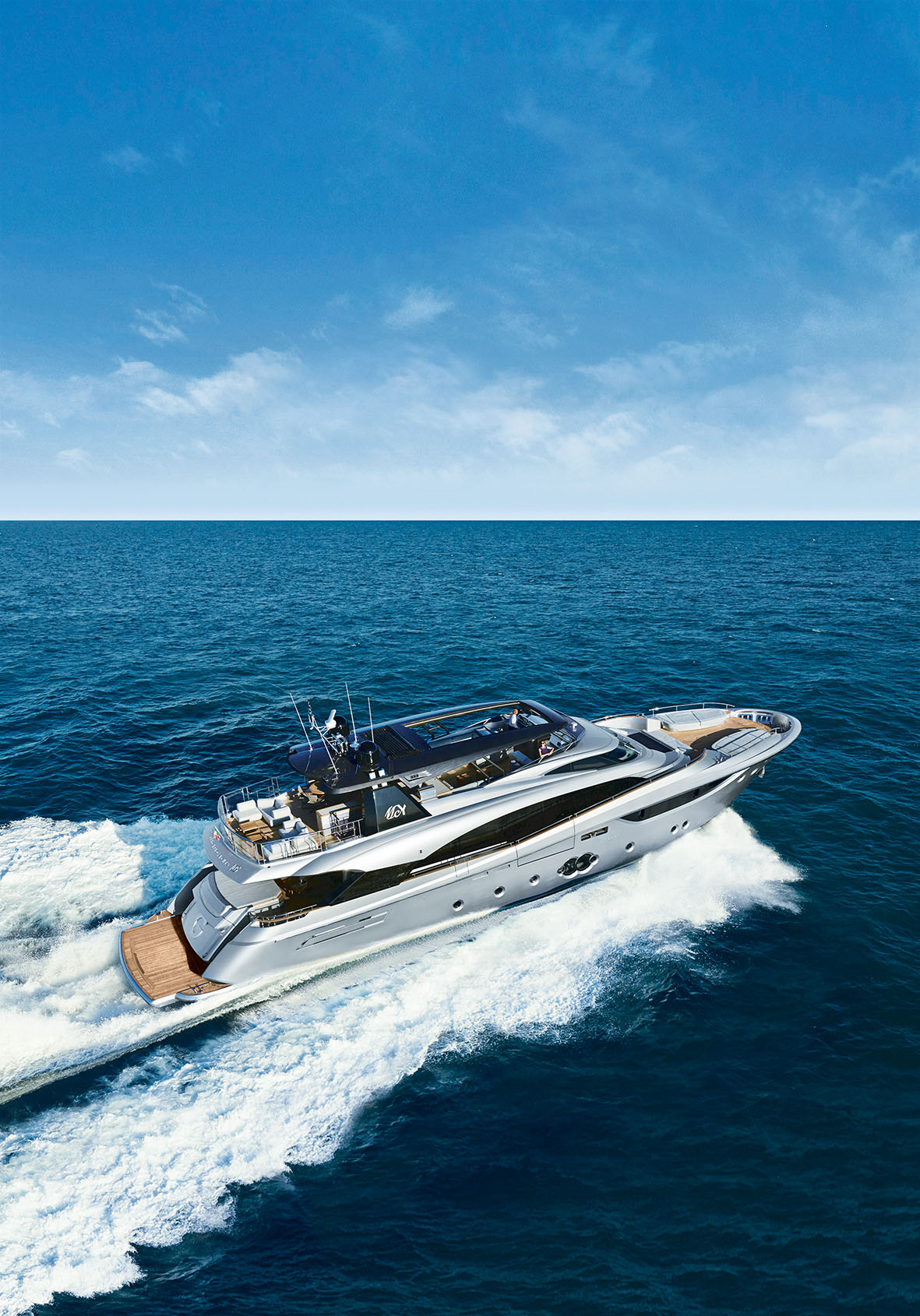
Clue number two: I have to wait before I begin my tour (I arrived a bit early… just a day early. I actually got the wrong date, but luckily the person I have to meet is there, and I don’t have to go back to Milan), I wait for around half an hour in the waiting room. Around me there are four offices with transparent walls, and they are all full, each of them with two people who are talking face to face, either side of a table. Job interviews, a friendly receptionist confirms.
Clue number three: while waiting I bump into a friend, a young architect who has just started work here and has moved from the Brianza area. I ask for some information, what is it like to work here on the inside? Her first words? «There is a lot of work, really a lot». And then more talk.
So: the figures are growing, they are taking on people and there is a lot of work to do. But let us put aside what are merely clues, and let’s move on to full, factual proof. Federico Peruccio, manager of Monte Carlo Yachts tells me all the figures of the shipyard from its creation until now.
The amount of business grew from year to year, from 3 million euros in 2010, to 11, 23 and 37 million, reaching 72 million in 2016. Steeper still is the growth curve for employee numbers: starting at 20 in 2010, then 100, 180 and 250 up to 440 currently. Over its eight years of existence, MCY has launched one model a year (with the exception of 2014), starting from the 76 and getting to the 96, this year’s new launch. It is amazing to think that everything started when the nautical sector (and not just that) was creaking, and badly.
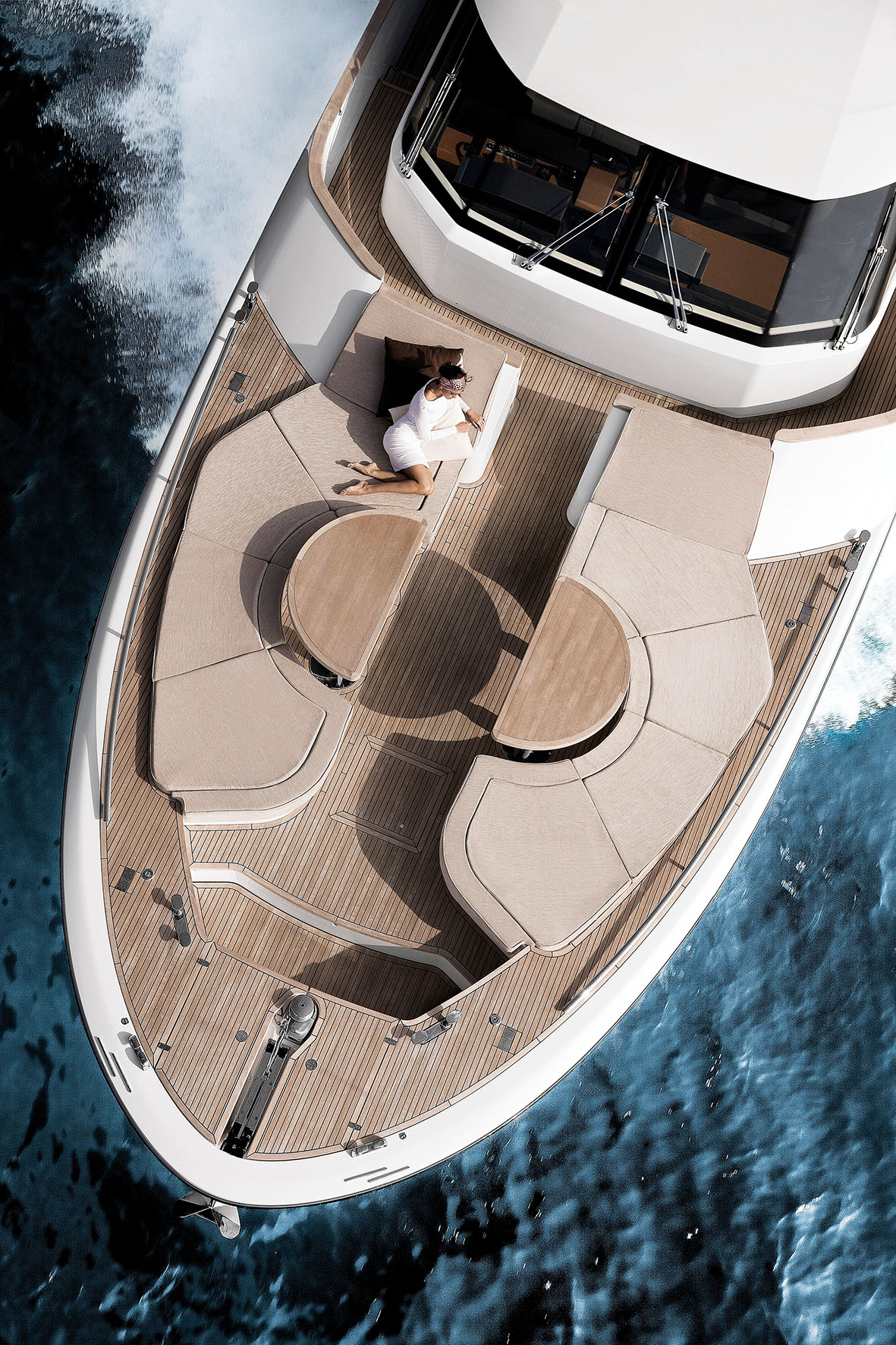 The crisis meant that firms had to close and employees had to be laid off. But Bénéteau, especially Madame Annette Roux, decided to try to take advantage of the crisis, and make the most of their position as market leaders. And so came the idea of launching a brand of Bénéteau-manufactured large yachts, and to do so in the place which has the greatest tradition in the world in the sector, Italy. And with strictly Italian management. Carla Demaria took over as president of Monte Carlo Yacht, and at her side was Fabrizio Iarrera as managing director.
It was a double challenge: because of the difficult economic situation and because of the principle that lay behind everything: «But how can Bénéteau, which to everybody is a symbol of affordable pleasure boating, start building mega yachts? It’s madness».
But it would appear that they were long-sighted, and clear sighted as well. Once you have the vision, then you have to deliver it. The Bénéteau Group might have deep pockets, patience and a desire to invest, but you need results too. How did they get them? There are two key concepts: production process and project quality. So on one side a new way of building boats, faster, more efficient, more precise. On the other the ability to fit all of this into the right receptacle. The right shapes, both above and below the waterline.
Let’s start at the beginning. You just have to build boats from the bottom upwards, as people always have done. Fill in the bilges and then go upwards. No longer are there dozens of people banging into one another putting up equipment. The building process is programmed from the start, in every detail and focuses on the final outcome. That certainly isn’t anything new in the industrial world, but when applied intelligently to the nautical world, it is a rarity. Let’s see how it works. Assembly takes place here at Monfalcone, the VTR is worked (rigorously for every element, even the smallest, and always using infusion) in the facilities a few km away. There are three separate lines, one for the interiors, one for the decks and superstructure and one for the hull and the core machinery. 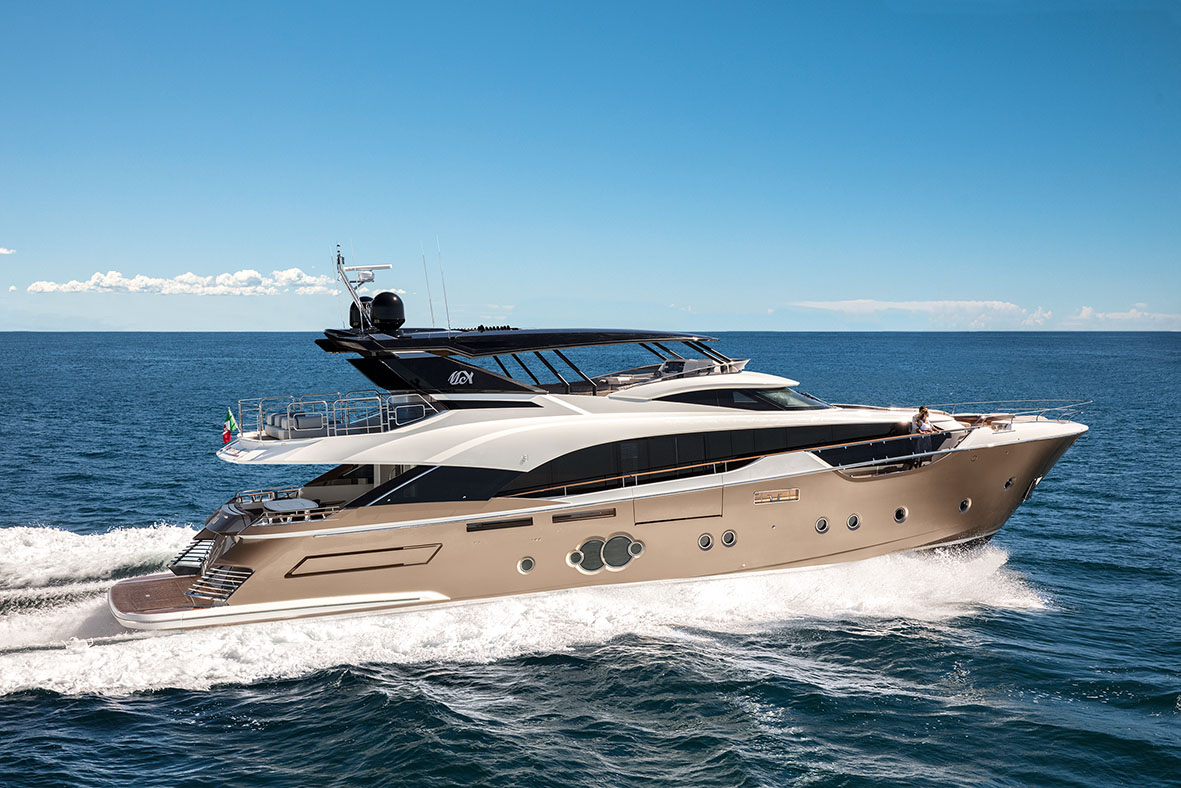
Employees can work at their own height on each of these lines, both from the interior and the exterior, with complete freedom of movement. The pieces are ready, numbered, cut using computer numerical control and organised on the trolleys to be put together. The module holding the interiors does not rest on a traditional fibreglass tray, but is structured on an aluminium structure on which everything else rests. Between the aluminium and the structures there is a layer of rubber, which varies in density according to requirements, which stops any vibration from being transmitted. Above the flooring, before the carpet, another layer of rubber is added. The choice of aluminium (rather than VTR, or even wood) has three advantages: it is more adaptable (and great flexibility in customising interiors is one of the key points on which the yard’s philosophy is based); it is lighter; and finally it means you can easily create a system of natural channels where the cabling and tubes can run. This is aluminium skeleton, which ultimately creates an aeronautical style strengthening structure which runs from stern to bow, and from one side to another.
The interiors module is not fixed to the hull by binding, or VTR or resin. Instead glue is used, something else that comes from aeronautics. The result of all this is not just a very high level product, with the highest standards in terms of quality, comfort and reliability, but they also manage to do it in half the time of the others. To make a 105-foot boat, with a high degree of customisation, four and a half months are required.
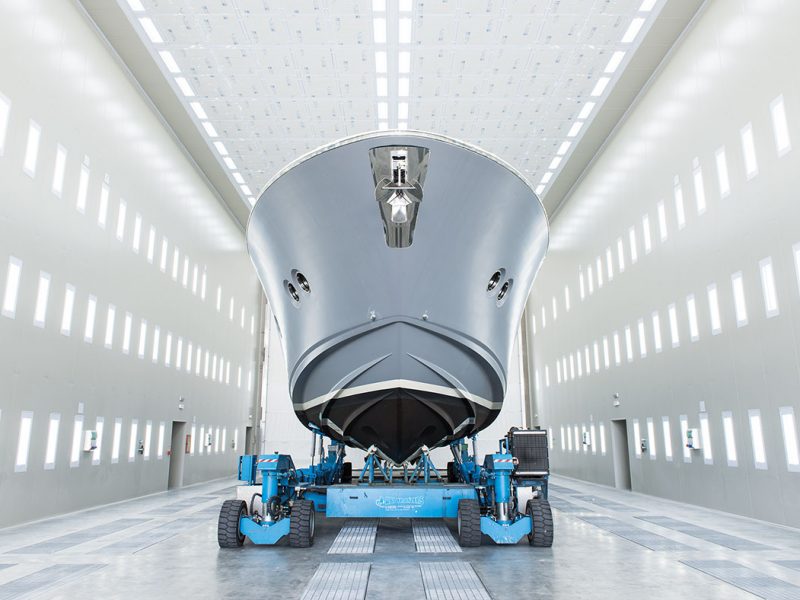
Another fundamental step to note is in the 60-metre painting cabin. This is temperature-controlled and so as well as being used for its main task, it is also used to subject the boat, before delivery, to a preventive cycle of treatment which simulate its first season in the water. What is the purpose of this? The VTR is a “living thing”, and automatically experiences small surface movements. You have to know what they are, and prevent them. We end with MCY’s second secret, designing shapes. As we said, they don’t just study the process, but also focus on producing good “containers”. That means, out of the water, being able to count on the Nuvolari e Lenard design studio, which doesn’t need much introduction. They have designed some of the most ground-setting mega yachts in modern yachting, and with MCY they have found an unmistakeable style, elegant but a bit daring, and very much linked to the sea. This last part is a style which is also reflected underneath the waterline.