The first pleasure ship by Monte Carlo Yachts marks the grand debut of the Italian-French brand in the mega yachts field
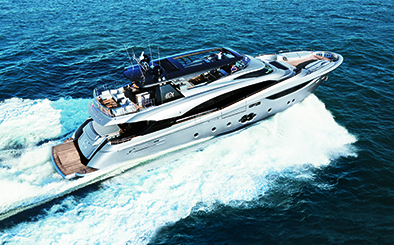
“NOTHING SPLENDID HAS EVER BEEN ACHIEVED EXCEPT BY THOSE WHO DARED BELIEVE THAT SOMETHING INSIDE THEM WAS SUPERIOR TO CIRCUMSTANCE”. Carla Demaria might well have been inspired by the words of Bruce Barton, one of America’s most celebrated advertising gurus of the first half of the twentieth century, when she thought of founding a new shipyard in Italy with the French group Bénéteau. And, after only five years of activity, from zero to 53 million Euros turnover in 2015, it is a splendid achievement indeed. Not by coincidence ‘Beyond the Promises’ was the title of the international press conference which presented Monte Carlo Yachts’ latest flagship, styled once again by Carlo Nuvolari and Dan Lenard. The 105 has sleek and aerodynamic lines with a high and well-angled bow, sides lightened by large windows, a massively proportioned flybridge, with huge fully retractable soft-top, and a generous aft swim platform, all of which blends harmoniously with the minimally curated interiors. One of the strengths of this 32 by 7.15 metre 104 ton dry displacement pleasure craft is the forward master suite on the main deck, which minimizes barriers to the entry of natural light and has a stunning panoramic sea view without denying space to the VIP suite and the other two twin cabins. Another great solution, which facilitates navigation and assures safety in manoeuvres, is the direct connection via internal stairway between the steering position on the flybridge and the control station on the main deck.
The forward Portuguese bridge, right from the beginnings of the range, has been a great functional element that goes to show, from a cultural point of view, that we are on board a ship truly designed to navigate and not just host happy hours in a trendy marina. One of the most innovative aspects of the Monfalcone shipyard concerns the thoroughly studied construction of the boat, with every detail defined at the design phase to leave absolutely nothing to chance and to avoid any critical modifications during assembly. Hull, bulkheads and deck are built simultaneously and then the propulsion system is inserted into the hull while installing the majority of auxiliary equipment and furnishings in the internally subdivided frame. When these two steps are complete, the interiors are perfected to a sub-millimetre tolerance. Bulkheads and hull are then joined by bonding with aeronautical-derived products, before adding the deck complete with already finished flybridge. The remarkable increase in speed of construction and greater quality of the product resulting from the ease and convenience of assembly also leads to a lower overall production cost. The hull has a deep-V variable geometry with aft deadrise of 16.3° and has three support strakes per side. The engine room houses two 2,434 horsepower MTU 16V 2000 M93s with V-drive ZF 3060 V inverters, 110mm-diameter Aquamet 22 shaft and Nibral 4-blade propellers, allowing the ship to reach a top speed of 25 knots. With a loaded weight of 123 tons, there is a power to weight ratio of about 25 kilograms per horsepower unit available. Such a high value sheds light on the excellent characteristics of the hull and overall equilibrium of the whole craft. During our test run in Venice, we really appreciated the low noise values recorded generally and in particular in the owner’s suite with just 57 decibels at cruise. The day gave us a slight westerly ‘Borino’ of about 10 knots and some long gently rolling waves, conditions of tranquillity that nonetheless allowed us to test the qualities of such a large boat.
The sensation of controlled power is exhilarating and sends a shiver down your spine when you think about holding the wheel of a craft that weighs over 100,000 kilograms. With good hull lines and the MTU engines well-suited to the size and characteristics of the boat, planing comes in 12 seconds from standstill with progressive throttle interval at 19 knots. From planing minimum to max engine revs took us 23.1 seconds. At 1400 rpm we were at 13 knots with only one turbine in action out of three for every engine consuming a total of 250 litres of diesel per hour. The second turbine took us to 1600 and 14 knots and the third to over 2000 rpm with a total consumption of 600 litres at 20 knots. Steering is smooth and response is pretty immediate even in tight alternating turns, manoeuvres not generally performed during normal cruising. Circling at cruising speed, for a minute and 20 seconds, completes a full turn with a radius of about 50 metres, impressive for a 32-metre craft. Inclination is negligible and only slightly more engine power accelerates the closing of the full turn. The boat moves agilely and rapidly on the spot with only two engines in operation and without the intervention of the bow thruster.
MONTE CARLO YACHTS SPA
Bénéteau Group
Monfalcone (GO)
T.+39 0481 283111
www.montecarloyachts.it
PERFORMANCES AND DETAILS
Project: Nuvolari & Lenard (design) • LOA 32.00m • Length 31.61m • Max beam 7.15m • Draft under propellers 2.15m • Unload displacement 104 t • Full load displacement 123 t
Engines: 2 MTU 16V 2000 M93 2,434 hp (V-Drive) • Fuel tank capacity 12,000 l • Water tank capacity 2,000 l • Stabilizers: 2 Seakeeper NG35
Classification: RINA Pleasure or RINA Charter Class Certification
(Monte Carlo Yachts MCY 105, new era – Barchemagazine.com – October 2015)