The shipyard is always looking for solutions to make the boats easier to handle, such as a furling mainsail on the boom
by Niccolò Volpati – photo by Nicolas Claris
Since its beginning, Lagoon has been committed to making cruising as comfortable as possible. And catamarans have a big advantage over monohulls. For example, the 46′ has an overall length of 14 metres and a beam of eight metres. The design project is the result of a partnership between VPLP Design and Nauta. With the yard’s investment in R&D, the two design studios worked together to find the perfect balance between usable space and performance under sail. They went from a desktop computer design to a prototype and then to three models to understand what problems might arise. And finally, if all goes well, they will move to full production. To balance the need for space on board with performance, it was decided to move the sails aft to make room for a substantial genoa, albeit a self-tacking one. This is necessary both to produce speed and to get the best wind angle. It’s no secret that upwind sailing is the Achilles heel of catamarans. This decision has also meant that the boom is not too large and the mast is not keel stepped to increase space in the dinette. That’s not something that is going to compromise safety, since they have instead fitted a smaller mast base. The ongoing quest to simplify life on board and handling the catamaran has led the yard to develop an unusual boom furling system for the mainsail.


The design of the dinette, partly due to the lack of a keel-stepped mast, allows you to make the most of the space available. The cabins and bathrooms are located in the hulls, as is normal on a catamaran. The project is the result of the collaboration between VPLP Design and Nauta who worked to find the perfect compromise between volumes and performance.
TWIN 57HP ENGINES MEAN EXCELLENT PERFORMANCE, EVEN WITHOUT SAILS, AND YOU CAN CRUISE HAPPILY AT EIGHT KNOTS.
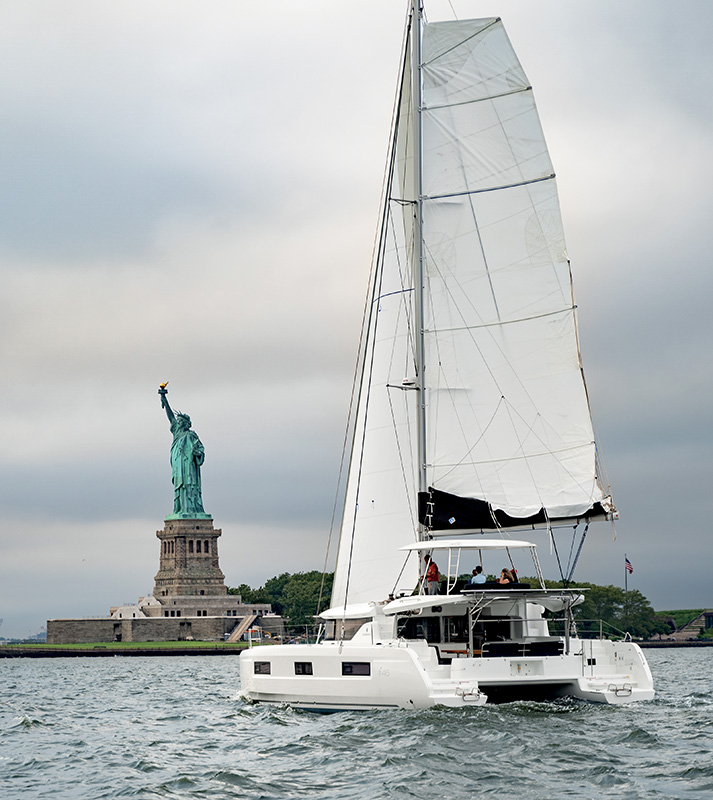
What is the main problem with furling sails? That they are smaller than the traditional ones, but with the Lagoon they had no intention of making them smaller, precisely so as not to sacrifice performance when under sail. The system, which is now available for all of the models from 46 to 51 feet, has a gearing system outside the boom, which the main halyard wraps around. And that is, of course, directly connected to the boom which furls around itself, raising and hauling down the sail. The advantage is that because the gearing is external, there is no need to have a very voluminous boom. The second advantage is that it means the sail surface is not sacrificed. Indeed Lagoon say that the main sail is the same size as a non-furling sail. The problem is that, especially lower down, the mainsail sticks out five inches or so from the mast and is attached to it by a lot of couplings. The doubt remains that over time it may become worn, and that these couplings won’t work perfectly any more. I saw that hauling up the sail takes around five minutes, during which time you have to stay completely in irons facing into the wind. And lowering it is also something that takes some care: if you do it too quickly you can even jam it, and then you will struggle to raise it.


WITH A HULL ENTIRELY DEDICATED TO THE OWNER, THE MASTER VERSION HAS THREE CABINS.
The Lagoon 46 sea trial
The wind in Barcelona wasn’t especially strong. During the test it was blowing at around ten knots. That made it the perfect opportunity to see how the boat performs. And looking at the figures, it was more than satisfactory. I was always sailing at between five and six knots, and it was fine going upwind. Passing over the waves wasn’t bad, despite the fact that further out to sea they were nearly a metre high. Although it should be said that it doesn’t hold course exceptionally well, especially with a following sea. With a quartering sea rather than one right on the stern we had to work hard to anticipate the effect on the rudder to stop zig-zagging. I believe that it was a matter of structure and in some ways was actually inevitable. It is a catamaran with an eight-metre beam, so with the two hulls some distance from each other. And if the boat is taking the waves on the quarter, they hit one hull before the other, preventing the Lagoon 46 from moving in a straight line. You quickly get used to it, and if you take the right precautions and anticipate in the right way, you don’t have problems in keeping on course. This means that the two rudder blades are quite deep, so it’s not difficult to steer the boat in the direction you want.


You don’t need a large crew to sail the Lagoon 46, with electric winches, halyards and sheets all close to the wheel. Comfort and performance, that is what the sail plan is all about. The sails, made by Incidence, have been specially tailored for the Lagoon 46.
IT HANDLES VERY WELL WITH THE SAILS SET, AS YOU DON’T NEED MUCH WIND TO GET IT GOING. THE RUDDER BLADES ARE SET LOW, WHICH MEANS YOU CAN CHANGE COURSE IN HEAVY SEAS.
There is only one wheel, located in the centre of the fly-bridge. The lines of sight are good, even with the sails furled, except in the case of the genoa, which obviously blocks the view. The halyards and sheets are set slightly diagonally and are on the port side, partly because the wheel is in the middle. There are plenty of places to sit, starting with the sofa, so the person steering the Lagoon 46 won’t be alone. Access to the flybridge is also excellent. Normally the ladder takes up valuable space in the cockpit. But here it is “broken” in the sense that the steps from the cockpit face outwards to access the side decks, and then there are further steps in the opposite direction to access the fly bridge and helm station. As far as the layout of the interiors and decks is concerned, the volumes available mean that every wish can be fulfilled. Some solutions are very effective, such as the sofa on the flybridge that folds down to form a sunpad, and others are customisable, such as the number of cabins, from a master cabin to a charter layout.
LAGOON
162 quai de Brazza
CS 81217
F-33072 Bordeaux Cedex
T. +33 (0)557 809280
[email protected]
www.cata-lagoon.com
PROJECT
VPLP Design (naval architecture) • Patrick le Quément (exterior design) • Nauta Design (interior design)
HULL
LOA 13.99m • Maximum beam 7.96m • Draft 1.30m • Displacement 16,600 kg • Water tank volume 600 l • Fuel tank volume 1,040 l • Waste water tank volume 240 l • Sailing surface 140.10 m2 • Main sail surface 87 m2 • Genoa sail surface 50.5 m2 • Code 0 sail surface 110 m2
MAIN PROPULSION
2×57 hp Yanmar 4JH57 • Outlet mechanical power 41.9 kW (57 hp) • 4 in-line cylinders • Swept volume 2.19 l • Saildrive with foldable blades
EC CERTIFICATION
CAT A
PRICE
686,800 € as standard, Excl. VAT (September 2024)
(Lagoon 46 – The search for comfort – Barchemagazine.com – Excerpted from Barche, September 2024)