Interceptors, stabilising fins, control unit, gyro-compass and accelerometer. This is the Humphree system, capable of boosting the performance of any boat
by Niccolò Volpati
Two blades immersed in the water. Arethey a help or a hindrance? I have to confess that my instinct is to answer that they’re a hindrance, but that’s not the case. The weather in Palma de Mallorca is ideal. Rain, strong wind and waves. Perfect for testing the Humphree system, which essentially consists of three things.
An electric stabilising fin under the hull, two interceptors, or two blades at the far end of the stern that can be raised and lowered, and an electronic control unit. The interceptors have been designed to make the flaps redundant. The ambitious aim is to reduce consumption, boost speed (and already these two things together make me turn up my nose) and, lastly, optimise the boat’s trim. Meanwhile, the stabilising fin, like all fins, promises to reduce rolling at “zero speed”, that is to say when stopped at anchor and even when on the move. The control unit acts like an orchestral conductor because, according to Humphree, these elements – if well coordinated – can produce a better result than any boat with independently operated stabilisers and flaps. We shall see.

The first boat we step aboard is a Targa 48 Fairline, equipped with only the stern interceptors. The wind is blowing between 25 and 30 knots, the waves outside the breakwater are more than a metre high and the bucket loads of water hitting the windscreen are a mixture of seawater and rainwater. One of the indisputable advantages of this system is its automation. Simply press a button to get it up and running.
We set out with the interceptors switched off. The boat behaves as you would expect in these weather conditions. Then I press the button and the difference is immediately apparent. And there is more, the displays reveal an increase in speed and a reduction in consumption. There’s no trick, no deception. I’m at the helm and I’m therefore certain that no one has touched the thrust levers. Consumption is around 15% lower at almost every speed. The speed increases (not much, in truth), but despite the two blades in the water, the boat doesn’t slow down and instead goes faster.
And there’s more. In this case, it’s a question of sensations rather than figures. The trim of the Targa 48 is perfect. As soon as the interceptors are activated, the boat draws in parallel to the surface of the sea. It’s no longer stern-heavy and we have gained visibility. The sensation is also good when turning. The heeling angle changes with and without interceptors. The boat is level, tilts less and does not even suffer when the waves of more than a metre high break onto the side of the hull. In short, as well as improving performance, they produce a sensation of added safety.
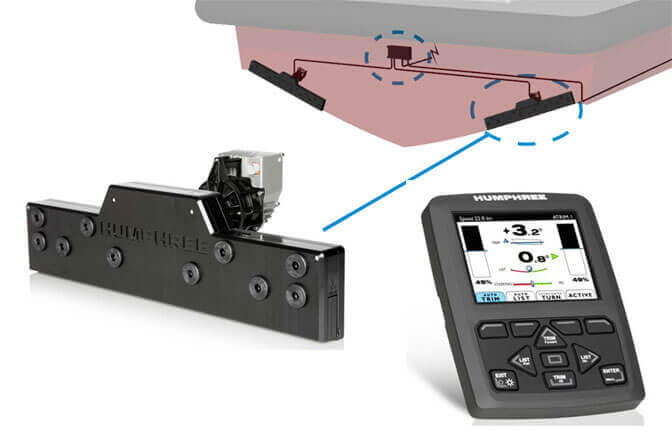
There is a noticeable drop in rolling during navigation too, even with the thrust lever right down. Landegren, CEO at Humphree, and Steffen Faldt, marketing director for Italy, explain that this is due to the surface area of the interceptors. Effectively speaking, almost the entire V shape immersed in the water at the stern is covered by the two blades. Unlike flaps or trim tabs that have a very contained surface area, interceptors act as a frame for almost the entire hull structure at the far end of the stern. More surface area is synonymous with more stabilisation and rolling is not noticeable, even when the waves are side on.
Our second outing is in the Sunseeker 82, which is fitted with . In fact it has two, measuring one metre. As regards the benefits during sailing, the same considerations made for the Tarthe complete system of interceptors and finsga 48 apply here too. It is all very easy, thanks also to the automatic system. I look at the dedicated display and notice that the blades are raised and lowered very rapidly, independently from one another. This also explains the beneficial effect produced on the trim during sailing. The fins also produce a noticeable result, particularly with the engine in neutral.
They are able to rotate by 360° at Zero Speed, meaning that they can combat the rotation effect both when at anchor. Rolling is significantly reduced, particularly because we are positioned across the waves at the entrance to the harbour. The worst spot. We encounter the choppy sea and the wakes of those going in and out. In a normal situation, without stabilisation, I’m sure that a few people on board would turn white, then green, and would risk being sick after a few minutes of this.
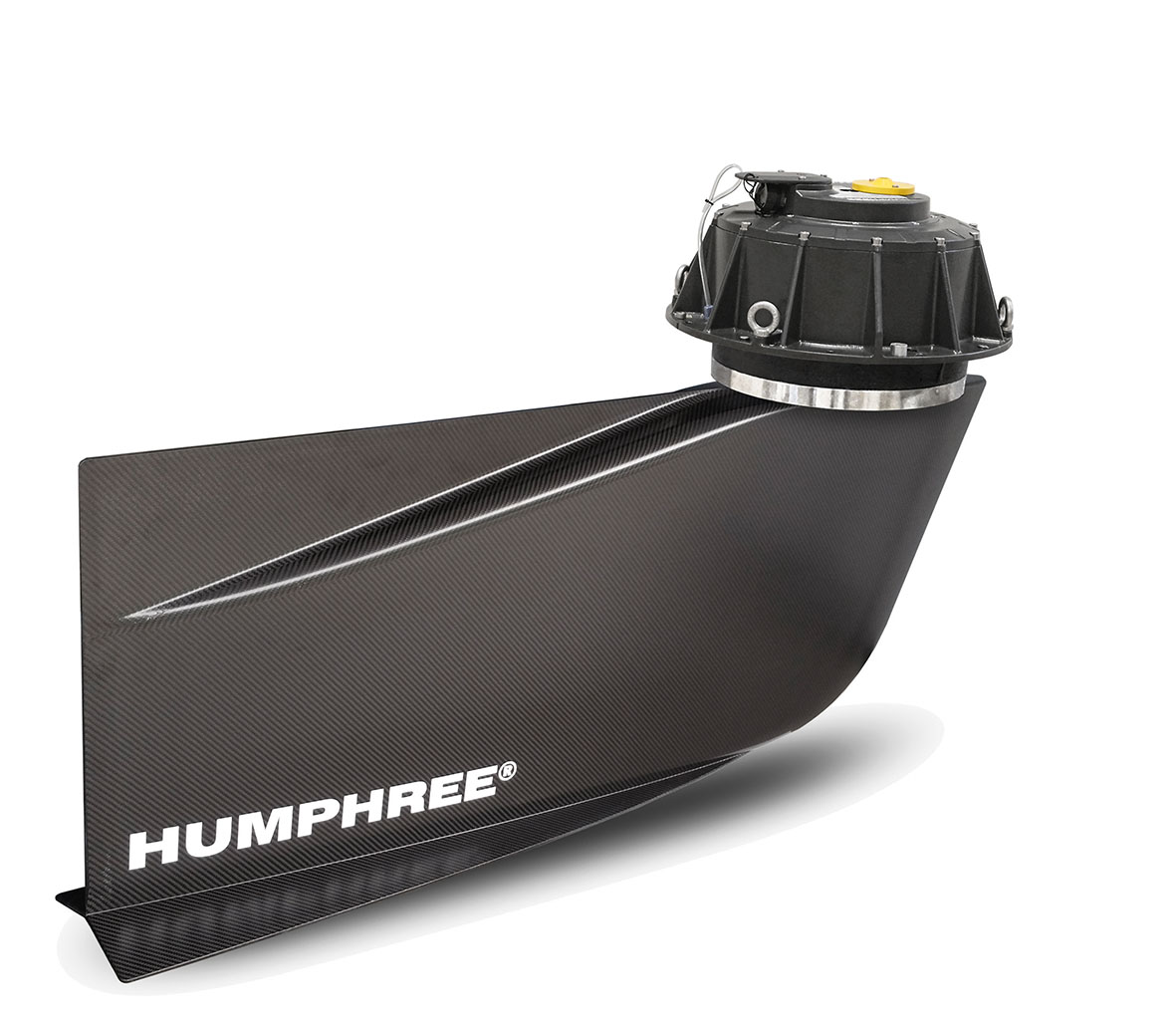
However, thanks to the Humphree system no one seems to be suffering. Not even when climbing onto the fly. The boat is stable, the fins combat the motion of the waves and do so very quickly. The company tells us that the effect is produced within just 0.7 seconds of the order being imparted by the electronic control unit.
This is thanks to a system that also has an accelerometer and a gyro-compass. The fins have been designed with a large sacrificial section, in the sense that if you hit the rocks, the lower part of the fin breaks off without breaching the hull. One also gets a good sensation in the engine room, where the electric engine produces very little noise. Technicians and engineers have worked hard to achieve this result and the sound level meter I use to record the decibels supports their claims. Much less from the engines, obviously, but also much less from the generators and other systems. What is more, they’re powered at 24 volts and so they don’t need to run on a generator.
The actuator has been made as small as possible. Its internal dimensions are practically non-existent. The only thing that is not in their favour is the fact that the fins are immersed. Nevertheless, Humphree claims that they do not have a negative effect on sailing and also point out how a good weight, such as that of a gyroscopic stabiliser, alters the characteristics of the hull, changing the trim and the waterline. Lastly, we come to a detail that is perhaps not so indifferent, and that is the price.

The costs are decidedly affordable. The interceptors and fins are available in different sizes, suitable for boats from 12 to 50 metres or more. Generally speaking, the system for a medium boat can cost € 5,000 for the interceptors and € 6,500 for the fins. For just € 11,500 you can buy the complete system that provides an optimum trim at all times during sailing, making it possible to improve performance, reduce consumption and, lastly, stabilise the boat when moored and when at sea.
(Humphree, how to achieve the ideal trim – Barchemagazine.com – Settembre 2018)