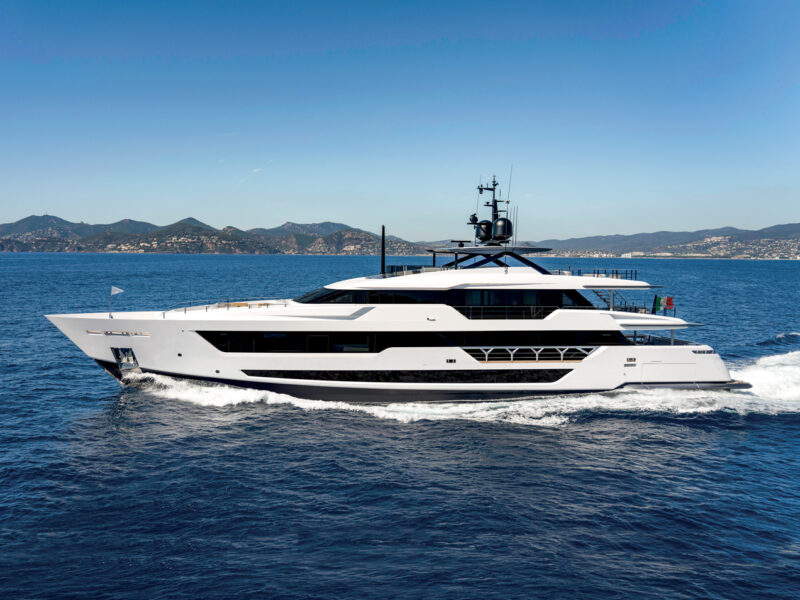
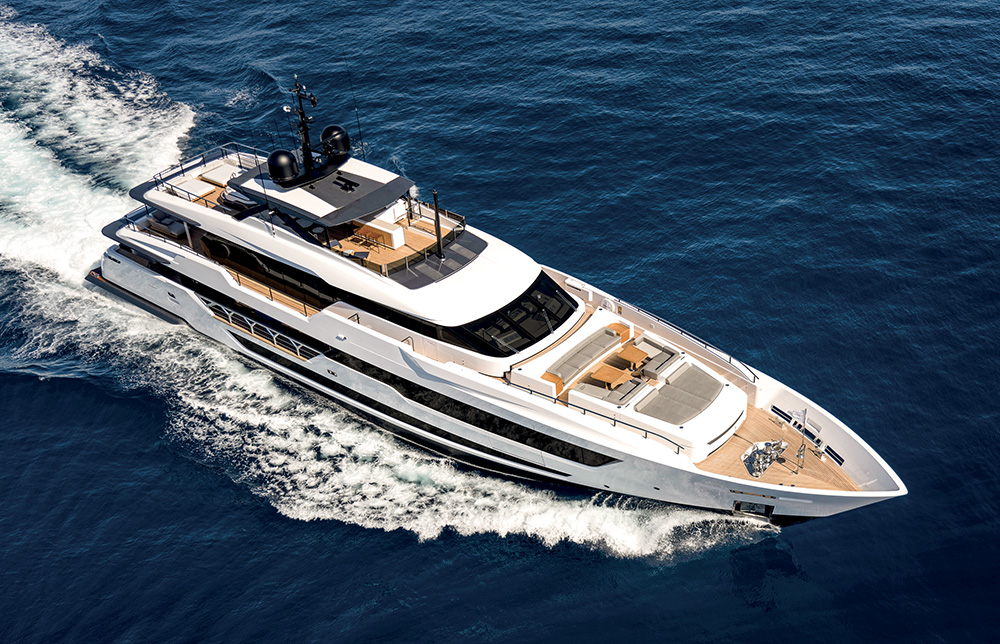
Francesco Paszkowski has introduced distinctive new features in this new semi-displacement yacht, which is 42.61 metres long, with a maximum beam of 8.54 metres and a top speed of 21.7 knots
by Maria Roberta Morso – photo courtesy of Custom Line
Drawn up in partnership with the Ferretti Group’s Strategic Product Committee and engineering department, the 140’is the third Custom Line boat to bear the mark of Francesco Paszkowski Design for both inside and out, while Margherita Casprini and the Custom Line Atelier also worked on the interiors.
With a fibreglass and carbon fibre build, and a semi-displacement hull, the Custom Line 140’ – which has a gross tonnage of just under 400 tonnes – manages a top speed of 21.7 knots, and is powered by two MTU 16V 2000 M96Ls, each developing 2,638 horsepower. That is a confirmation of the sporty spirit of this new Custom Line model, one that has unquestionably been designed with passenger comfort in mind, while not forgetting about some lively performance characteristics, which mean that you can get to your destination quickly.
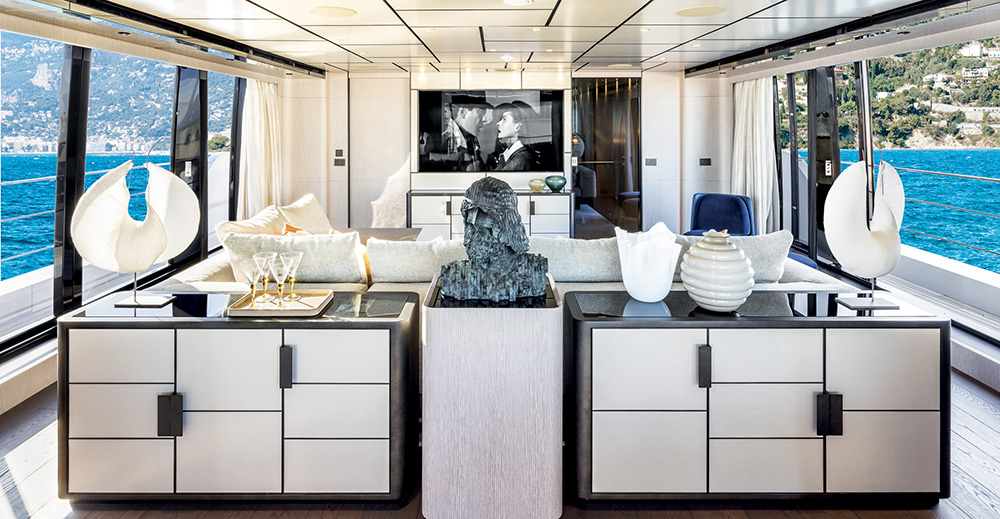
The main saloon covers 45 m² and has a dining and living area that features a rich palette of materials and furnishings, including natural leather, elements of ivory and a dark oak parquet floor.
The Custom Line 140’s flaunts decisive exterior lines, with angular features and large, dark windows ending in sharp points giving the outline a dynamic feel. A new feature comes in the shape of a section of bulwark alongside the main deck saloon, with a balcony made from four aluminium Y-sections inserted below the gunwales. That is a pretty distinctive element, which as well as its look has a functional value since it means that whoever is in the lounge can admire the view. The socialising area also has full-height windows, which on the starboard side open onto the side deck.
The owner’s apartment has a sea view, is full beam and covers 44 square metres. It has a double walk-in wardrobe and the bed is located centrally. The panelling in ribbed light wood, set around the mirror at the end, reflects all of Custom Line’s skill and craftsmanship.
The yacht spreads over three decks, plus a large sun deck. The layout is traditional, in that the social areas and the private owner and guest areas, along with the main lounge, are on the main deck, and the master suite is in the bow. The large guest cabins are located on the lower deck, and there is a panoramic lounge on the upper deck. The interiors and exteriors flow together seamlessly creating a very large area, which is in close contact with the surrounding nature. The routes taken by the crew have been planned to ensure guest privacy, as well as functionality for service requirements.
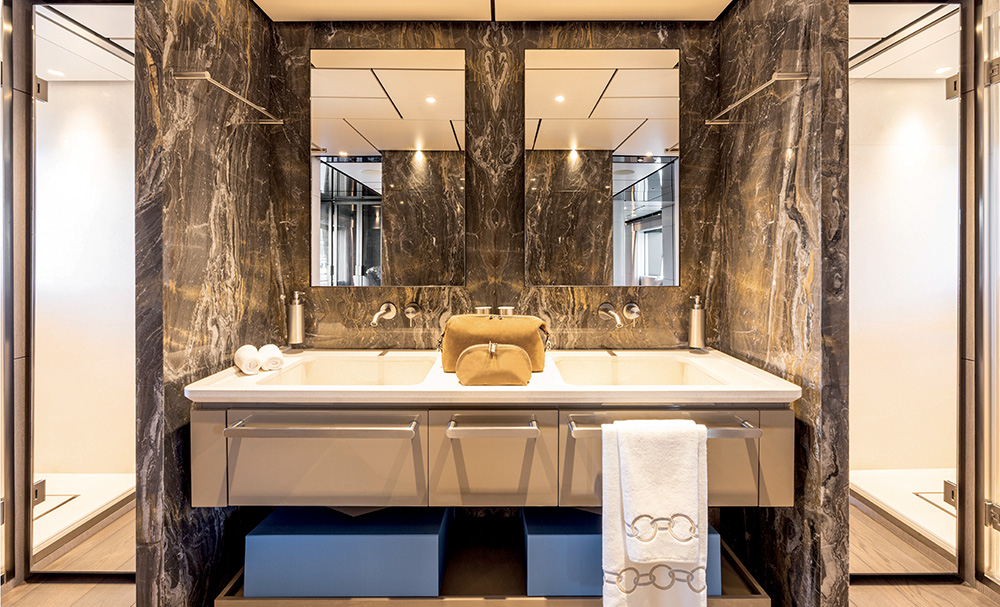
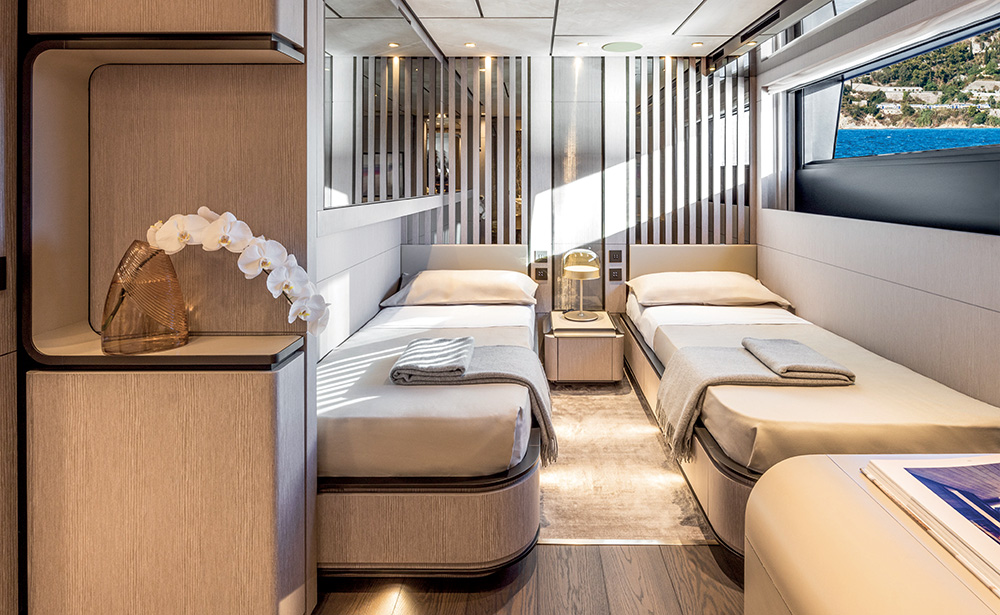
The lower deck houses three VIP cabins, and a guest cabin with two twin beds. Each has its en suite bathroom, while the colours, materials and design features reflect the same approach as on the main deck, with mainly natural turtle grey and beige colours.
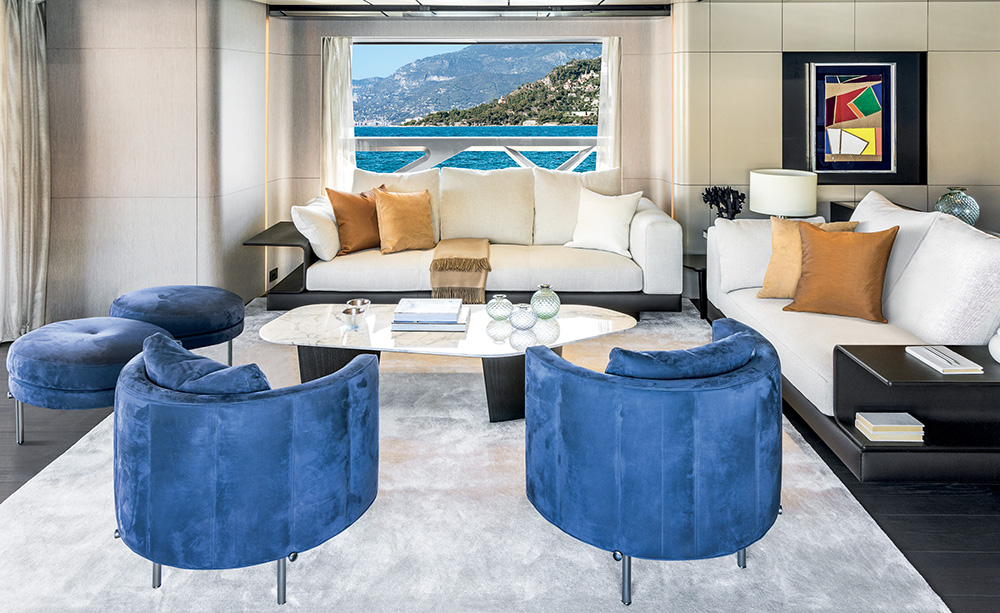
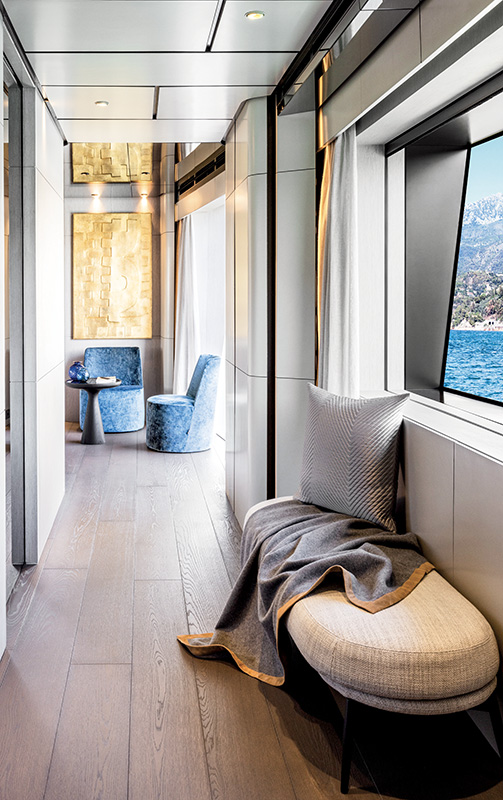
The main deck hosts the guests with a large cockpit set up with free-standing furniture and, when the doors are completely open, the outdoor lounge becomes an extension of the interior one. The manufacturers say that the interiors cover a total of 300 square metres, which are in addition to the 200 outside. The lounge in the boat we saw was done up in contemporary style, with neutral panel colours and furniture that is enlivened by the intense blue of the armchairs, the decorative cushions, the artwork on the walls and the beautiful coloured vases by Venini.
The boat is laid out across four floors, in which the areas designed for socialising create a single area joining inside and out. The areas for the owner and guests are kept completely separate from the crew areas throughout the boat.
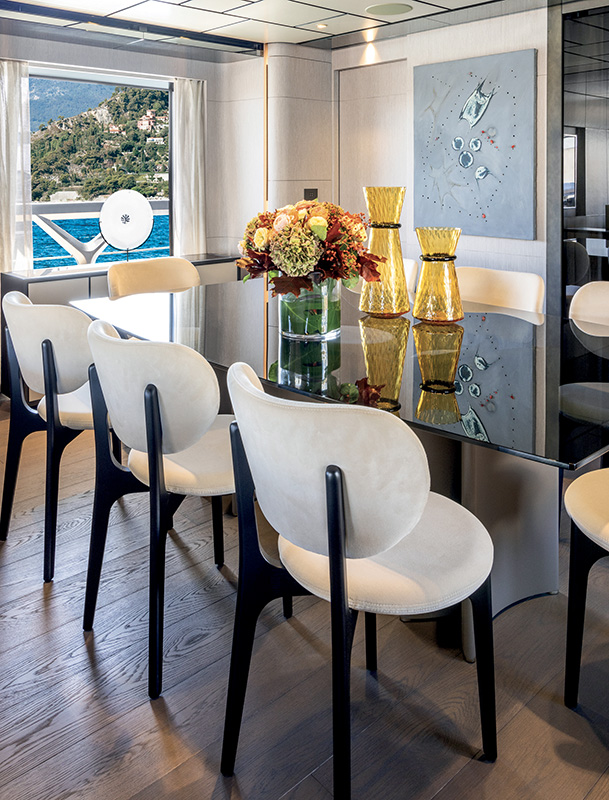
The large windows and mirrored ceilings create a very luminous environment, which benefits from a good view. The mirrored surfaces have been used intelligently on more than one occasion to create the impression of greater space and to add depth. The sofas, in the lounge, are from the Connery collection by Minotti, as well as the small and elegant Tape armchairs, designed by the Japanese studio Nendo, which is headed by the celebrated designer Oki Sato. The low marble coffee table is from the Song range. The lounge also incorporates the formal dining room, where the Alan table by Morada – with a glass top held up by Canaletto walnut half-moon legs – takes up to twelve diners. The furnishing has the same style, and uses the same material and colours, throughout the yacht, including both private and public areas.
The Paszkowski/Caprini combination has included various pieces by some of Italy’s top furniture producers, and this makes both the interior and exterior even more beautiful, producing a distinctly sophisticated environment. The yard does, of course, offer every buyer a high degree of customisation when it comes to furnishing. Staying on the main deck, there is a handsome galley on the port side which is fitted out in stainless steel with Miele appliances, and this is supported by a pantry located between the galley itself and the dining room.
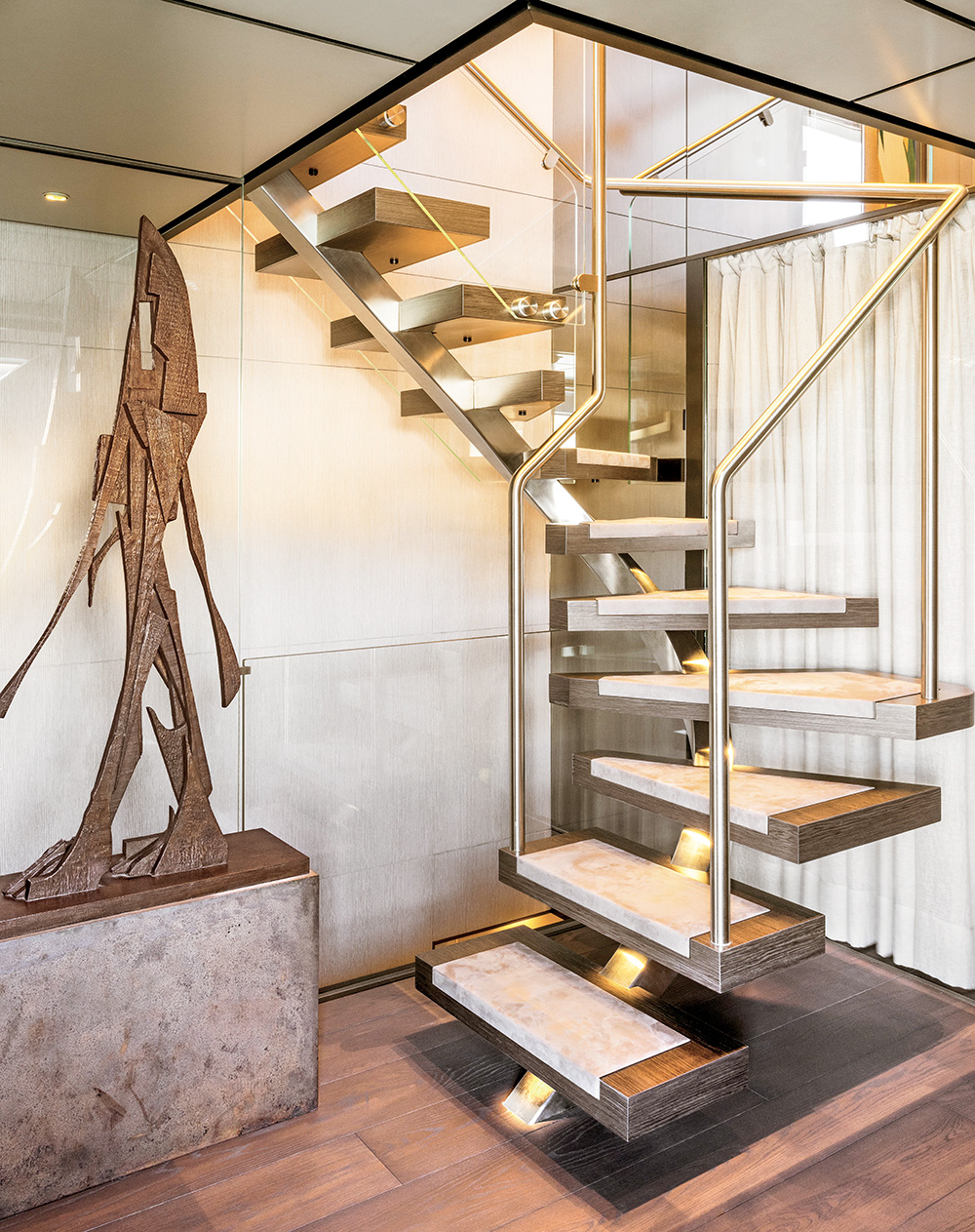
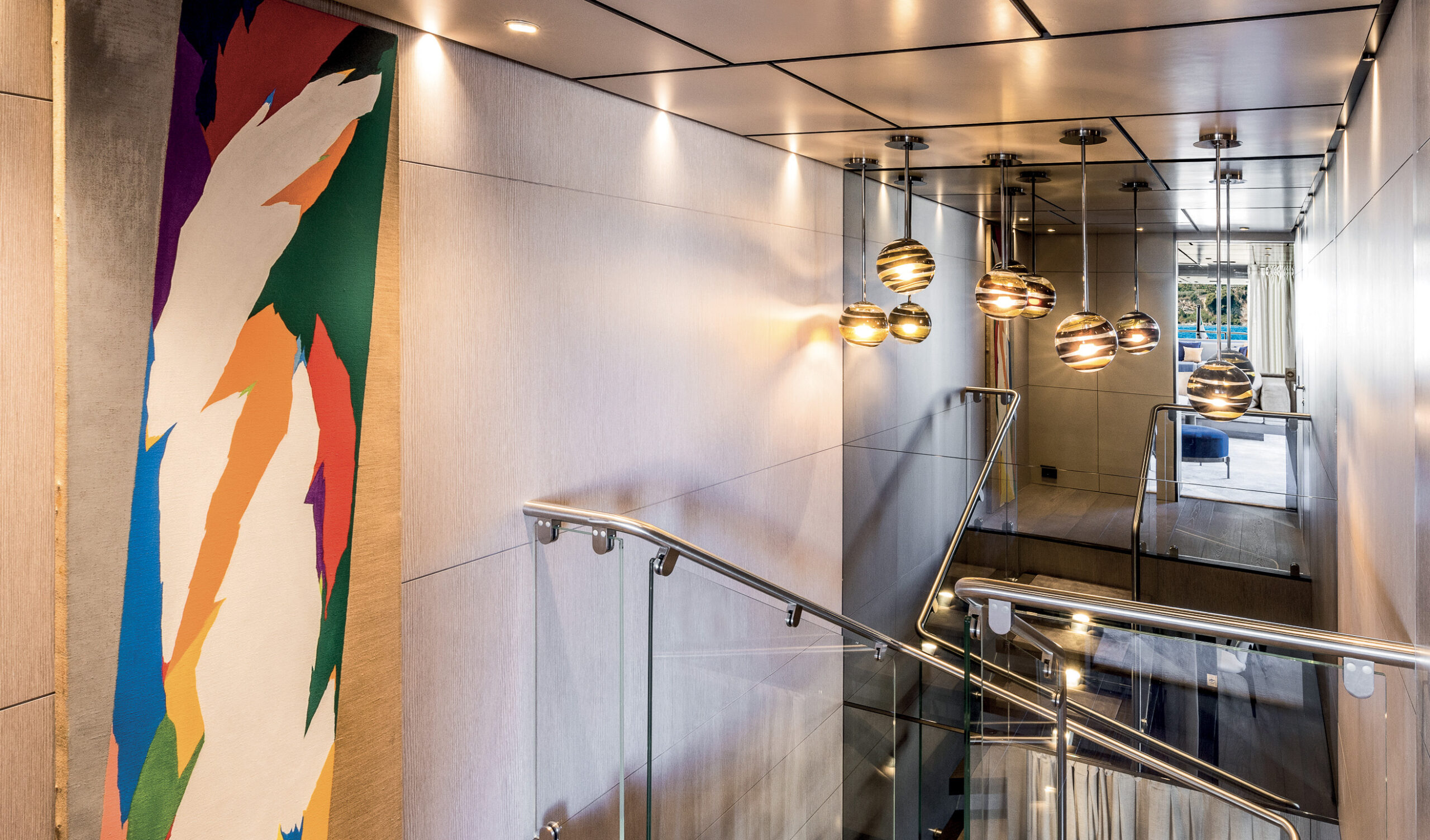
The central lobby features a minimalist staircase (with pendant lights in Murano blown glass) that brings together the main, upper and lower decks.
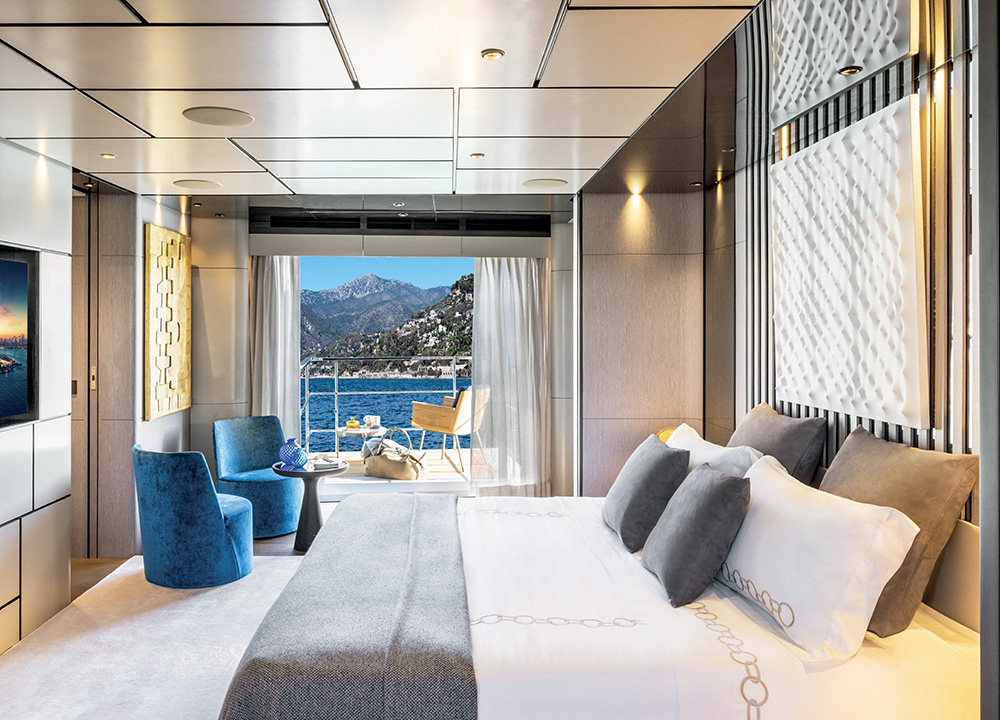
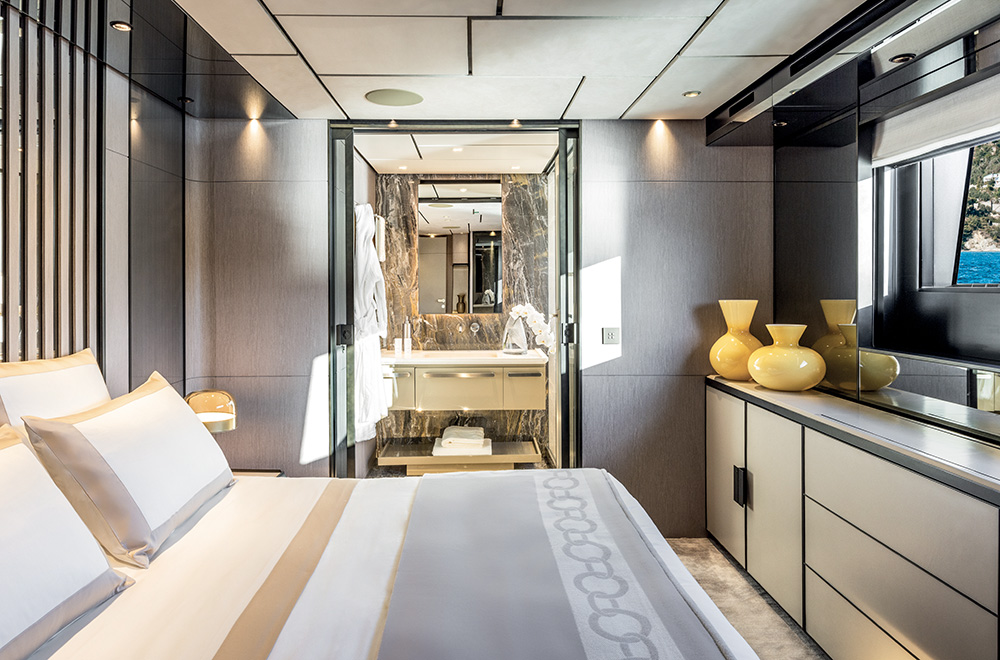
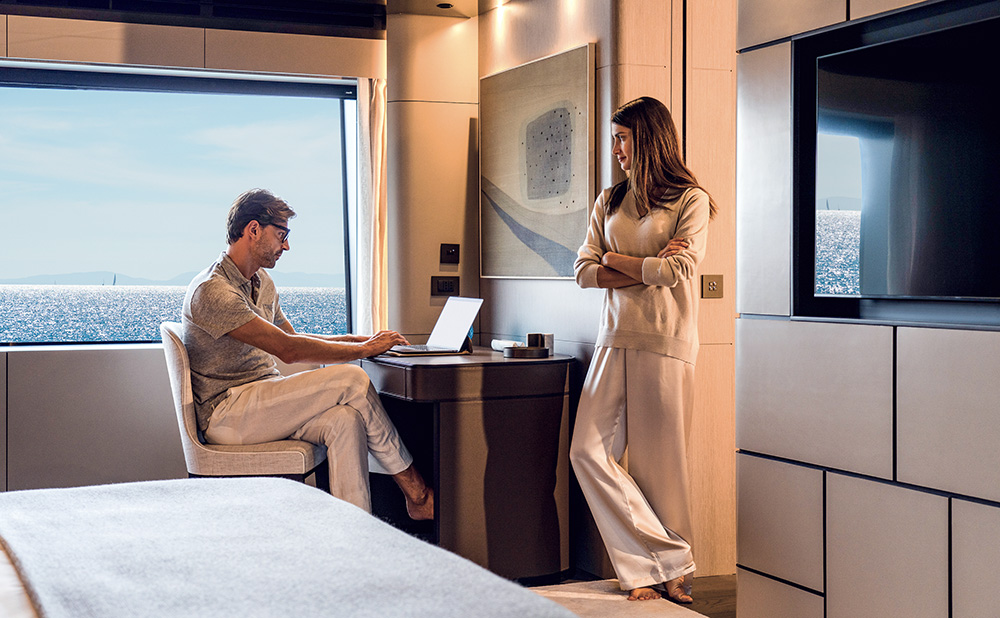
Going further forward we get to the master suite. Two large walk-in wardrobes open off the corridor, which leads to the sleeping area. The cabin is very luminous and, upon request, on the starboard side, you can have a terrace that opens out hydraulically (both the platform itself and also the rail move) which can be operated without the crew having to intervene. The bedhead is made from strips of wood set on a mirror, ensuring a very striking effect. The cabin includes an Amos desk designed by Roberto Lazzeroni for Flexform to starboard, and a socialising area with two blue Lea armchairs by Casamilano, designed by Paola Navone, to portside. The cabin, whether with or without a balcony, is thus a pleasant multi-functional area for the owners to use. There are four cabins on the lower deck, of which three are double and one twin. The three doubles have the bed positioned along the beam. As in the master cabin, one of the walls is made from strips of light wood set on a mirror to create the impression of false transparency and with it the feeling of space in the room. And, again as in the master cabin, there is no lack of designer furnishing – in this case the small Lithos pouffes are by Maxalto.
The crew area can be accessed in the bow on the same level, via a special staircase. As well as a compact dinette, there is a washroom and three double cabins. The captain’s cabin is on the upper deck, close to the bridge.
Comfort while underway or when moored is ensured by the Naiad 525 stabilising fins, and by three Seakeeper NG18 gyroscopic stabilisers.
In the stern, and beyond the engine room (which is reached from the passage on the port side), is the garage that opens to the side and which can house a tender of around five metres and a jet. There was a Williams Sportjet 525 on the boat we saw. The stern beach area, with adjacent indoor space, provides an additional outdoor area, right next to the water. As we go up two floors and admire the beautiful floating staircase that links the main to the upper deck, we get to a small hallway, which on the right gives access to the panoramic lounge that comes with a guest bathroom. The atmosphere in this smaller lounge is similar to the main one, and it has the same colours and sober furnishings.
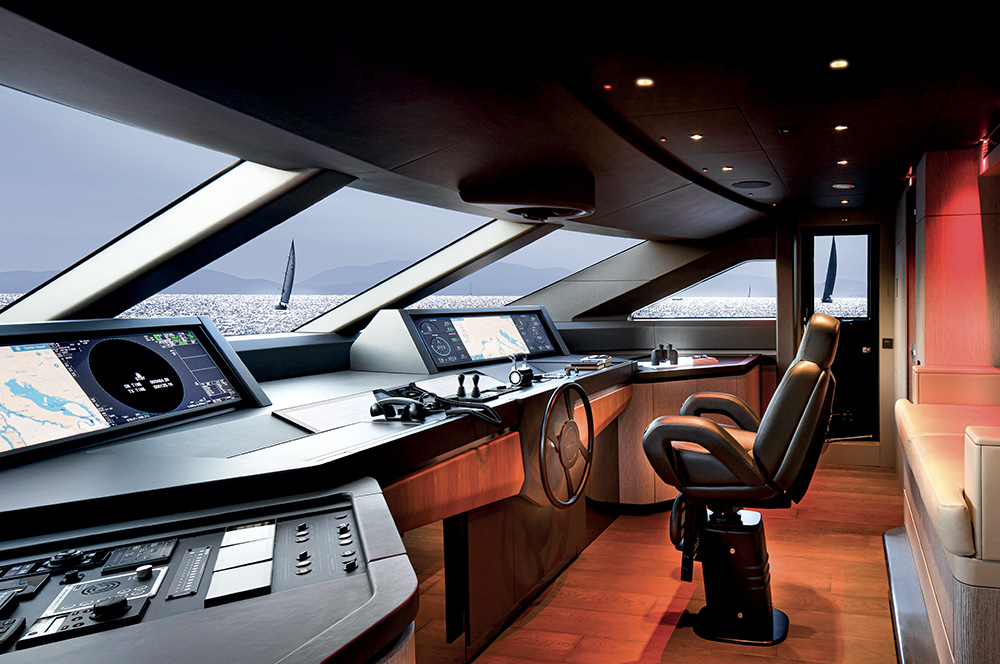
The helm station is fitted with the I-Bridge multi-control system, which gives complete control of all the different systems using a single, logical, intelligent and intuitive interface, made up of four touchscreen monitors, either 24 or 27 inches.
The helm station, which is on the same deck, is reached by a separate staircase, which leads out of the pantry on the main deck. The helm station is equipped with the I-Bridge Integrated Bridge Solution, developed by Team Italia, as well as four touchscreen monitors, from which you can control all of the onboard systems and check out navigation data. At this stage, it is worth turning our attention to the outdoor areas which, as we said earlier, play an important role, since they are linked to the interiors.
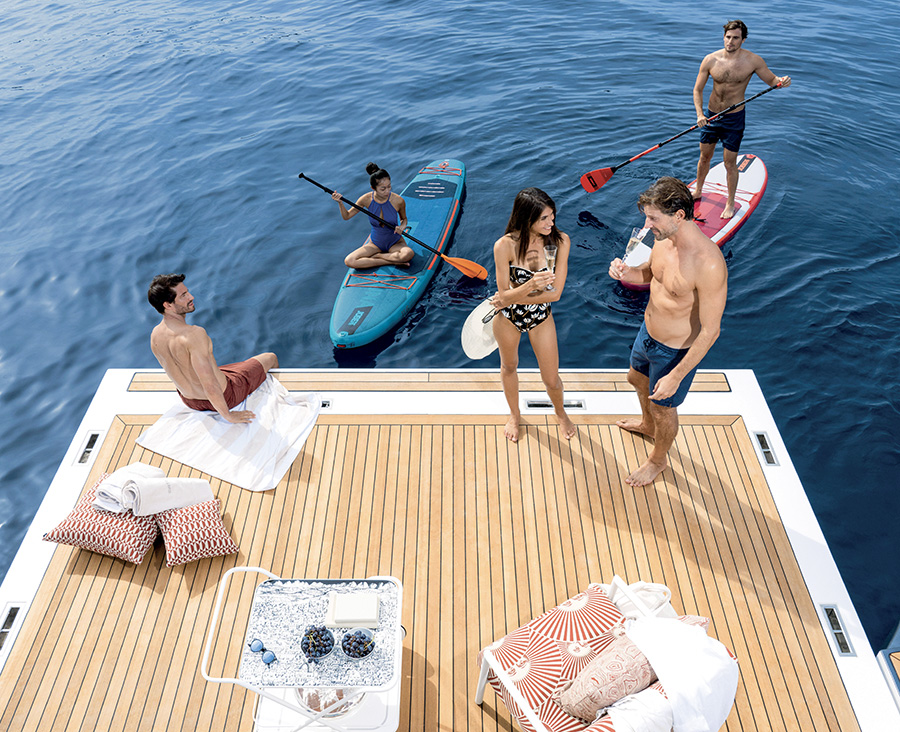
THE ENORMOUS STERN PLATFORM, WHICH IS EQUIPPED WITH THE LATEST GENERATION ELECTRO-HYDRAULIC SYSTEM, TURNS INTO A HUGE PRIVATE BEACH, THAT CAN BE CONVERTED INTO A LOUNGE AREA, AND IS COMPLETELY OPEN AND MULTI-FUNCTIONAL.
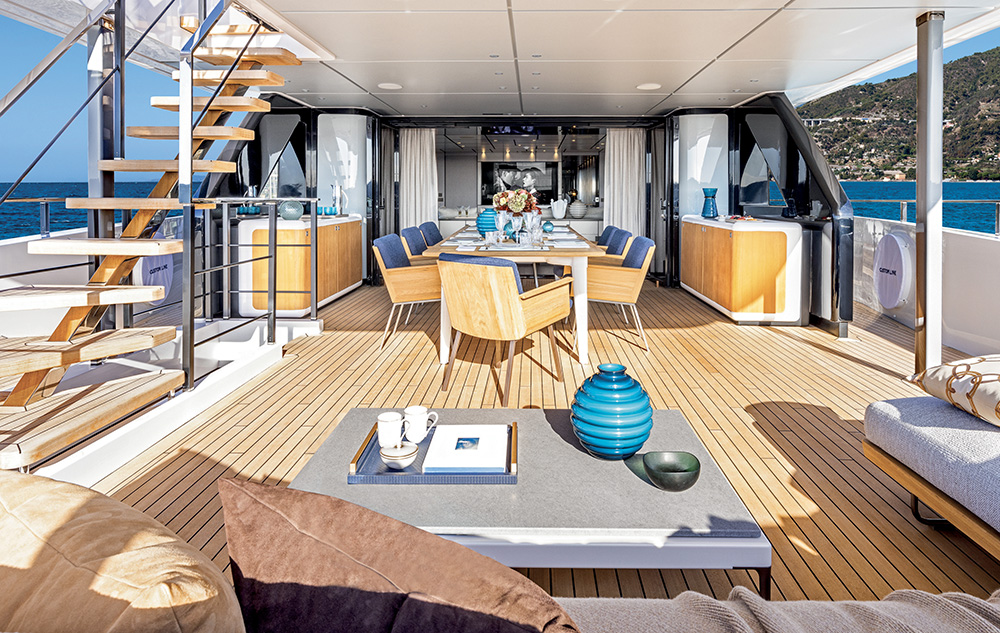
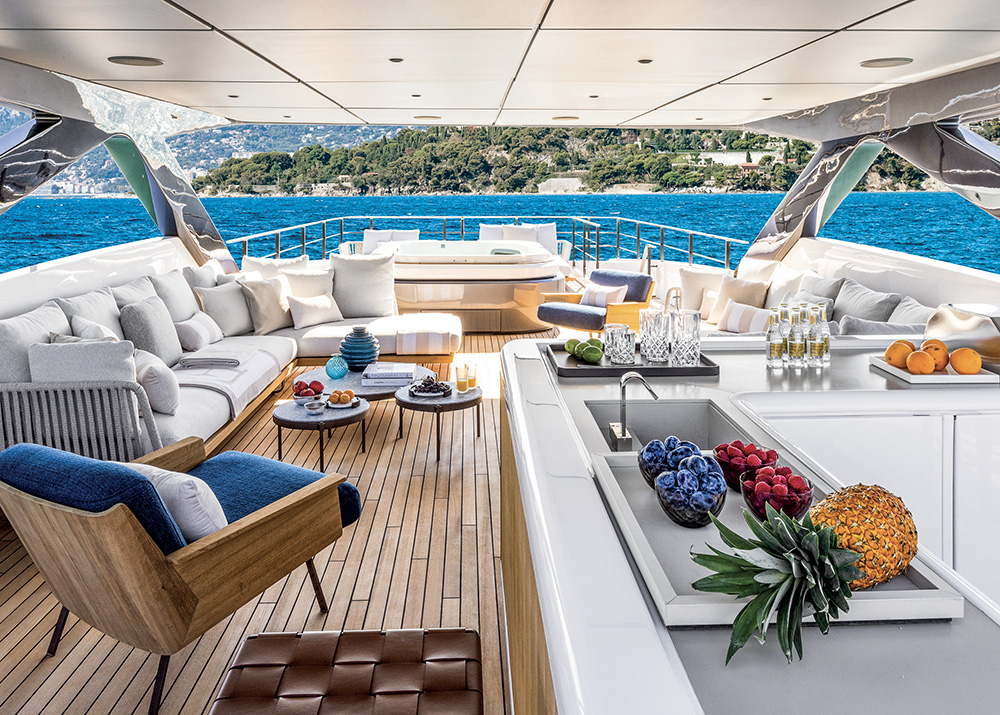
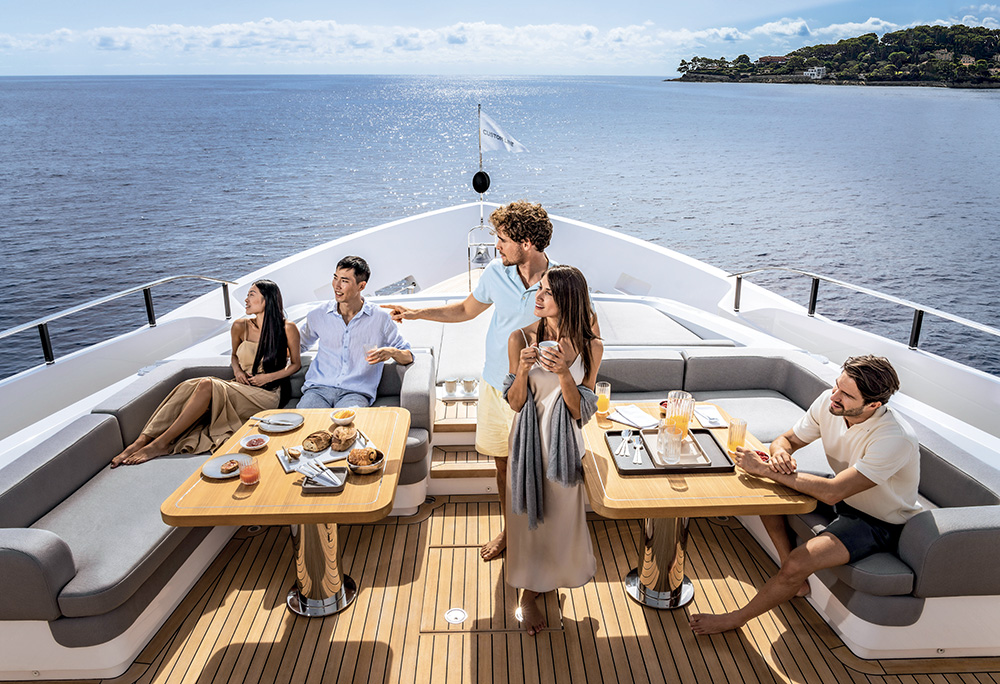
On the upper deck, a connecting door opens to join the panoramic lounge with the stern terrace, which has a lunch and socialising area right in the stern. This area for socialising is completely protected by the overhang from the sun deck. The feeling you get from it is a bit retro, a bit mid-century American, and brings to mind an elegant yacht of another era. The furniture is covered in teak, and the Daiki armchairs by Minotti (with their blue cushions) are also in teak, as is the large rectangular table they go around. The celebrated furnishing brand from Meda also takes centre stage in the relaxation area, where guests can enjoy a Sunray sofa in teak with a back in woven rope and soft cushions with an ecru cover. The same sofas can be found on the sun deck, together with a few Daiki armchairs.
There is a spacious relaxation area bathed by the sun going forward on the upper deck. It is made up of three fixed sofas, served by small tables, and two sun loungers. The largest outdoor area is the sun deck, which houses an area with comfortable sofas and an outdoor bar/kitchen shaded by the elegant carbon fibre hard top, a Jacuzzi located practically in the middle of the boat, and a sun pad area fitted out with two very comfortable (and very beautiful) large chaises-longues, which are again by Minotti, and again from the Sunday range. The Custom Line 140’s semi-displacement hull means it has a top speed of 21.7 knots, and a range of over 800 nautical miles at the 16.6-knot economy cruising speed.
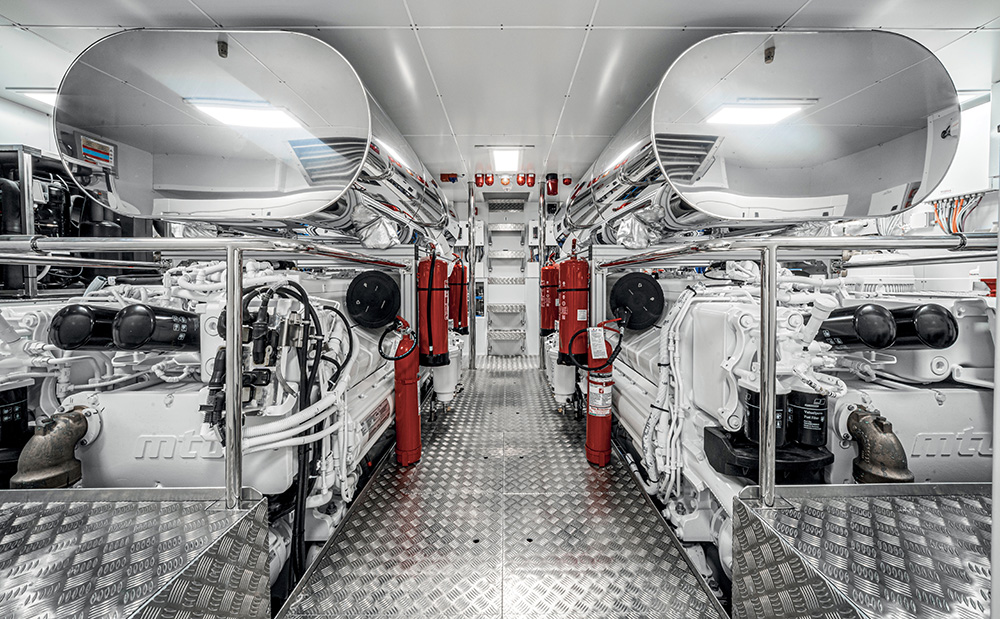
Engine room Power comes from a pair of MTU 16V 2000 M96Ls, each developing 2,638 horsepower. IMO Tier III certification for nitrogen oxide reduction is available upon request.
PROJECT Francesco Paszkowski (exteriors and interiors) • Margherita Casprini (interiors) • Ferretti Group’s Strategic Product Committee
HULL LOA 42.61m • LWL 36.3m • Maximum beam 8.54m • Draft 2.35m • Light mass displacement 225 t • Full load displacement 265 t • Fuel tank volume 29,000 l • Water tank volume 4,000 l • People on board 22 • Cabins 5 • Bathrooms 6 • Crew cabins 4 • Crew bathrooms 4 • Building material Vtr • Maximum speed 21.5 knots • Range 830 nm at 16.6 knots
MAIN PROPULSION 2x Mtu 16V 2000 M96L • 16 90°V-shape cylinders • Outlet mechanical power 2,638 hp (1,939 kW) each
EC CERTIFICATION CAT A
(Custom Line 140’, Clean and contemporary – Barchemagazine.com – March 2023)