Fb All-Weather 60’
Straordinaria
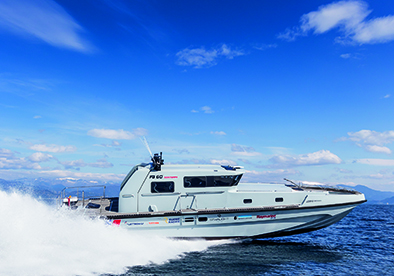
Fb 60’ Ognitempo è una barca progettata da Fabio Buzzi per la ricerca ed il soccorso che naviga a 60 nodi di velocità massima. Inaffondabile, direzionalmente stabile, è dotata di tanto spazio per ospitare fino a 100 naufraghi
OGNI VOLTA CHE INCONTRO FABIO BUZZI MI RENDO CONTO DEL POTENZIALE INESPRESSO DELLA NOSTRA INDUSTRIA NAUTICA. Se ci fosse la Repubblica della Nautica Italiana lui sarebbe il presidente perfetto. Una nazione dove ogni singola cosa è progettata per rispondere a un bisogno preciso e dove il superfluo è bandito. Fabio Buzzi è considerato il genio per antonomasia. Riconosciuto come il progettista di barche che più di tutti ha saputo innovare nell’industria nautica è una vera risorsa per il sistema. Nato a Lecco nel 1943, discendente di una famiglia di progettisti e costruttori edili, è un ingegnere, imprenditore e pilota motonautico italiano di successo. Inizia la sua carriera di pilota a soli 17 anni, correndo sul Po la Pavia-Venezia. Si laurea nel 1970 in ingegneria meccanica al Politecnico di Torino, portando come tesi un’automobile fuoristrada autocostruita, secondo veicolo progettato dopo aver già realizzato nel 1965 un’automobile Hot Rod. Realizza invece il suo primo scafo da corsa nel 1974: uno scafo tre punti chiamato Mostro, la prima imbarcazione al mondo ad essere costruita in kevlar 49, con cui conquista nel 1978 il record mondiale della classe S.4 alla velocità di 176,676 km/h. Nel 1971 fonda la Fb Design, originariamente con lo scopo di costruire barche da diporto, lavoro e soprattutto da corsa. Per anni l’attività principale del cantiere è stata infatti la competizione. In oltre 40 anni di attività Fb Design ha vinto 55 titoli mondiali e ha stabilito oltre 48 record di velocità in tutte le classi esistenti della motonautica. In concomitanza con il declino del settore motonautico agonistico, l’azienda ha utilizzato l’esperienza maturata nella progettazione di imbarcazioni veloci da competizione per ampliare la sua produzione verso il settore di scafi militari. Non si contano il numero di progetti vincenti. La sua ultima barca che abbiamo avuto l’onore e il piacere di provare è la sintesi della storia progettuale della Fb Design e di Fabio Buzzi. L’Ognitempo 60’ è una vera e propria concept boat che adotta i numerosi brevetti frutto della mente dell’ingegnere lecchese che ci spiega: «Abbiamo ricevuto, da molte organizzazioni in tutto il mondo, una richiesta costante per un nuovo tipo di barca search and rescue, Ognitempo, soprattutto a causa del nuovo tipo di missioni richieste oggi. Il problema migrazione è di giorno in giorno più importante, spesso arrivando a situazioni tragiche, soprattutto nel caso di mare mosso. Fb 60 Ognitempo è stato progettato dopo una attenta analisi di tutte le barche di questo tipo esistenti, troppo lente, costose e con spazio limitato a bordo». La lunghezza tipica di una barca Sar è 50 piedi, quelle più grandi sono difficilmente autoraddrizzanti e sono generalmente più lente. In questo nuovo progetto, a causa della grande necessità di spazio per ospitare persone salvate, la lunghezza è di 60 piedi con una larghezza di 4 metri, in modo da avere un più corretto rapporto lunghezza/baglio per la navigazione in acque agitate. L’Ognitempo 60’ è totalmente inaffondabile, grazie al sistema di Structural Foam, essendo riempita di poliuretano espanso a cellule chiuse di 75 kg/m3. La carena è a “V” profonda, 21° a poppa e 50° a prua, con due ordini di pattini longitudinali e un gradino trasversale, per garantire le migliori prestazioni alle alte velocità, riducendo la resistenza causata dall’acqua. Questa conformazione di carena consente, inoltre, di poter tagliare le onde, in caso di mare molto mosso, caratteristica fondamentale per uno scafo ognitempo, pur conservando la stabilità direzionale, che potrebbe essere compromessa da una ruota di prua troppo accentuata. I materiali usati per la laminazione dello scafo a “macrosandwich” sono fibra di vetro di qualità “E” e resina vinilestere. Lo scafo è strutturato con cinque longitudinali in compensato marino che sono fissati al fondo, irrigidendolo e formando la struttura resistente dello scafo, insieme alle 2 ordinate principali di prua. Questi rinforzi dividono lo scafo in 18 camere perfettamente stagne e il volume racchiuso è iniettato con schiuma poliuretanica a celle chiuse (densità media 70 kg/m3) che, una volta espansa, unisce lo scafo, la controstampata e i longitudinali. La coperta è configurata come un walk-around, senza corrimano esterno, che potrebbe generare problemi quando la barca si avvicina ad un’altra. Molto interessante il sistema brevettato di parabordi, estremamente robusto, costruito intorno ad uno speciale tubo di neoprene, rinforzato con un tessuto in poliestere, riempito con schiuma elastica e supportato da una base di poliuretano dedicato, intercambiabile in segmenti di lunghezza di 2,5 metri. I motori Mtu V10 di 1620 cavalli ciascuno sono stati realizzati in una versione speciale per alte prestazioni, con supporti più forti, una particolare coppa dell’olio e con sfiati olio riprogettati atti a superare inclinazioni estreme. Il sistema di trasmissione è lo Zf Trimax 3500 Surface Drive, estremamente affidabile, veloce e direzionalmente stabile. I timoni sono stati progettati per salvare la barca da contatti accidentali con rocce e parti galleggianti. Il sistema di controllo Tritab consente di assettare la barca in pochi secondi. La barca ha una massa a pieno carico di 25.000 chilogrammi e una velocità massima superiore ai 60 nodi. In caso di necessità, può salvare fino a 100 naufraghi. La cabina di guida ha un parabrezza inverso per avere una visibilità notturna migliore. Il visore notturno, progettato da Starlight Italia, visibile su uno schermo dedicato di 12”, 15” e 17”, progettato per migliori prestazioni in configurazione ad alta densità, offre una potente soluzione multi sensore girostabilizzata a 2 assi. Il sistema è dotato di un meccanismo di pan / tilt integrato che può ruotare in continuo di 360 gradi in orizzontale e in verticale. La velocità di rotazione è controllabile in un ampio intervallo con la forza applicata al braccio manipolatore proporzionale, e sulla stessa schermata è possibile visualizzare contemporaneamente due linee orizzontali, una con visione termica e l’altra con amplificazione di luce. Il sistema di controllo della navigazione si basa sul radar multifunzione, ecoscandaglio, chart plotter, AIS con superficie di destinazione registrata Arpa, pilota automatico, stazione meteo, esposizione di 8”, 12” o 19” con sistema di scambio di dati via satellite. Il sistema di comunicazione ha un Vhf radio e apparecchiature Gmdss su richiesta. Le porte, i portelli e le finestre sono resistenti all’acqua, essendo l’imbarcazione autoraddrizzante in caso di ribaltamento. Il vano naufraghi, sul ponte inferiore, ha un’altezza di 195 centimetri, può ospitare fino a 20 persone, ha una toilette dedicata e due passauomo apribili. La zattera di salvataggio, funge da divano e si compone di 4 parti diverse, 2 gonfiabili e 2 piene di poliuretano espanso a cellule chiuse, che può essere rapidamente smontata e gettata in acqua, per salvare in pochi secondi fino a 100 persone. La zattera viene normalmente utilizzata come un divano in cabina, ma può essere, in pochi secondi, trasformata in un letto per due o, quando gettata in acqua, utilizzata come 4 zattere galleggianti indipendenti. È costruita in Hypalon. La passerella a prua è la soluzione migliore per avvicinare altre barche in situazioni difficili e portare le persone a bordo in tutta sicurezza. Normalmente è gestita da due soli membri dell’equipaggio, mentre il conducente ha una visione frontale perfetta della piena operatività. In navigazione le prestazioni sono notevoli con punte di oltre 60 nodi di velocità massima, il rapporto peso potenza disponibile è di 7 chilogrammi per cavallo, la barca affronta virate improvvise a oltre 50 nodi senza scomporsi. Eccezionale la stabilità direzionale. È dotata anche di uno strumento che misura l’accelerazione di gravità che si manifesta quando lo scafo salta sulle onde di un mare molto formato, consentendo ai tecnici di valutare esattamente la resistenza strutturale della barca e di tutti gli oggetti di bordo. Gli impatti violenti dello scafo sulle onde sono assorbiti all’equipaggio senza particolari problemi e in totale sicurezza, grazie a 6 sedili Tecno G12 dotati di sistema di sospensione fino a 12G e cinture di sicurezza, indispensabili in caso di ribaltamento.
The FB All-Weather 60’ is a boat designed by Fabio Buzzi for search and rescue, which has a top speed of 60 knots. Unsinkable, directionally stable, providing a large enough space to accommodate up to 100 shipwrecked people
EVERY TIME I MEET FABIO BUZZI I REALISE HOW MUCH UNEXPRESSED POTENTIAL THERE IS IN OUR NAUTICAL INDUSTRY. If there was a Republic of Italian Sailing, he would be the perfect president. A nation where every individual item is designed to fill a specific need and where anything superfluous is banned. Fabio Buzzi is considered a genius par excellence. Acknowledged as the boat designer who, more than anyone, has brought innovation into the sector, he is a truly valuable resource for the system. Born in Lecco in 1943 to a family of builders and construction designers, he is a highly successful Italian engineer, businessman and powerboat enthusiast. He began his powerboat career at just 17, driving the Pavia-Venezia on the river Po. In 1970 he graduated in mechanical engineering from the Polytechnic University of Turin, with a thesis on a self-built off-road vehicle, the second designed by him following his Hot Rod car in 1965. He built his first racing powerboat in 1974: a three-point hull called Mostro, the world’s first craft made in Kevlar 49; in it he achieved the category S.4 world record in 1978, with a speed of 176.676 km/h. In 1971 he founded Fb Design, originally with the aim of building boats for leisure, work and, above all, for racing. Indeed, for many years the shipyard’s main activity was competitons. In its 40-plus years of activity, Fb Design won 55 world titles and established 48 speed records in every class of powerboat racing. With the decline of the powerboat competition sector, the company used the experience gained in the design of fast boats to expand its production into the military sector. Numerous successful projects followed. The latest boat we have had the honour and the pleasure of trying is the synthesis of the design history of Fb Design and Fabio Buzzi himself. The All-Weather 60’ is a real concept boat which features many patents by the engineer from Lecco, who explains to us: «From many law enforcement organizations worldwide we have received a consistent request for a new type of search and rescue boat, mainly because of the new type of missions demanded nowadays. The migration problem is becoming more important day by day, often arriving at tragic situations, especially in case of rough waters. FB All-Weather 60’ has been designed by a careful analysis of all existing SAR boats, too slow, expensive and with limited space onboard». The typical length of a SAR boat is 50’, the bigger ones are unlikely to be self-righting and are generally slower. In this new project, because of the great need of space to accommodate rescued people, the length is 60’, with a beam of 4 meters, in order to have a more correct L/b ratio, for navigation in rough waters. Thanks to the Structural Foam system, being filled with close-cell polyurethane foam of 75 kg/m3, the All-Weather 60’ is totally unsinkable. The deep V-shaped hull, 21° astern and 50° forward, with double lengthwise spray rails and a cross redan allows better high speed performances yet reducing the water resistance. The shape of this vessel allows it to cut through the waves in extremely rough seas, an essential quality in an “all-weather” boat, while maintaining directional stability, which might be compromised by an excessively accentuated prow design. The materials used for macro-sandwich laminating the hull are E-class fibreglass and vinyl ester resin. The hull structure has five longitudinal sections in marine plywood fixed to the base, giving it rigidity and structural resistance, together with the two main bulkheads. These reinforcements divide the hull into 18 perfectly watertight chambers and the enclosed space is injected with closed cell polyurethane foam (average density 70 kg/m3), that seals hull, counter moulding and longitudinal stiffeners. The deck is based on a large walk-around, without outside handrails, which could touch other vessels when boarding. The patented fendering system is really interesting: extremely robust, built around a special neoprene pipe, reinforced with a strong polyester fabric, filled with elastic foam and supported by a dedicated polyurethane base and interchangeable in segments 2.5 meters long. The Mtu V10 engines, 1620 hp each, have been built in a special version for high performance, with stronger supports, a special oil pan and special oil breathers. The drive system is the Zf Trimax 3500 Surface Drive, extremely reliable, fast and directionally stable. The rudders have been designed to save the boat’s structure from accidental contacts with rocks and floating parts. The Tritab is capable of planning the boat in a few seconds. The boat has a full load displacement of 25,000 kg with a top speed which exceeds 60 knots. In case of necessity, it can rescue up to 100 shipwrecked people. The driving cabin has a reverse windshield to increase the night visibility. The night screen, designed by Starlight Italia, is visible on a dedicated monitor of 12”, 15” and 17”, it has been designed for best performances in high density configuration, offering a powerful 2 axis gyro-stabilized multi sensor solution. The system has an integrated pan/tilt mechanism which may rotate continuously 360° horizontally and vertically. Rotation speed is controllable within a wide range with the force applied to the proportional joystick arm, and on the same screen it is possible to see simultaneously, with horizontal subdivision, thermal vision and light amplification. The navigation control system is based on a multifunction radar, echo sounder, chart plotter, AIS with recorded target surface Arpa, autopilot, weather station, display of 8”, 12” or 19” with data exchange system via satellite. The communication system: has a VHF radio and Gmdss equipment on demand. The doors, hatches and windows are all water resistant the whole boat being self-righting. On the lower deck, the shipwrecked compartment is 1.95 m high and can accommodate up to 20 people. It has a dedicated toilette and two openable hatches. The Raft8 Sofa is made up of 4 different parts, 2 inflatable and 2 filled with close-cell polyethylene foam, which can be quickly disassembled and thrown into the water in order to rescue in a few seconds up to 100 people. The raft is normally used as a sofa in the cabin, but can be, in a few seconds, transformed into a bed for two or, when thrown into the water, used as 4 independent floating rafts. It is built in strong Hypalon. The gangway at bow is the best solution to approach other boats in difficult situations and take people onboard in safety. It is normally operated by only two members of the crew, while the driver has a perfect front vision of the full operation. At sea the performances are excellent exceeding 60 knots at top speed, the weight/power ratio is of 7 kg per hp; the boat calmly faces sudden turns at over 50 knots. Directional stability is exceptional. The vessel is also equipped with an instrument that measures the gravitational acceleration that occurs during high seas navigation, allowing engineers to accurately evaluate the structural resistance of the boat and everything on board. Violent impacts of the hull on the waves are absorbed by the crew without particular problems and in complete safety, thanks to 6 Techno G12 seats fitted with suspension system up to 12G and safety belts, essential in case of capsizing.
SCHEDA TECNICA//PERFORMANCES AND DETAILS
FB DESIGN
Via Provinciale 73, 23841 Annone Brianza (LC) – ITALY
Tel +39 0341 260105 – Fax +39 0341 260108
www.fbdesign.it
Progetto Fabio Buzzi
Lunghezza fuori tutto 17.80 m • Larghezza massima 4.30 m • Motori 2 x MTU 2000 M94 1620 HP • Velocità massima (mezzo carico) oltre 59 nodi • Velocità di crociera 42 nodi • Autonomia 500 miglia nautiche • Cassa gasolio 5000 litri • Acqua dolce 260 litri • Equipaggio 4 ÷ 6 persone • Max payload 6000 kg • Dislocamento a vuoto 19000 kg • Dislocamento pieno carico 25.000 kg • Certificazione Ce categoria A
Project Fabio Buzzi
LOA 17.80 m • Max beam 4.30 m • Engines 2 x MTU 2000 M94 1620 HP •
Top Speed (half load) More than 59 kn • Cruising speed 42 kn • Range 500 nm • Fuel tank capacity 5000 l • Water tank capacity 260 l • Crew 4 ÷ 6 people • Max payload 6000 kg • Light displacement 19000 kg • Full load displacement 25000 kg • Certification Ce cat A
(Maggio 2016)