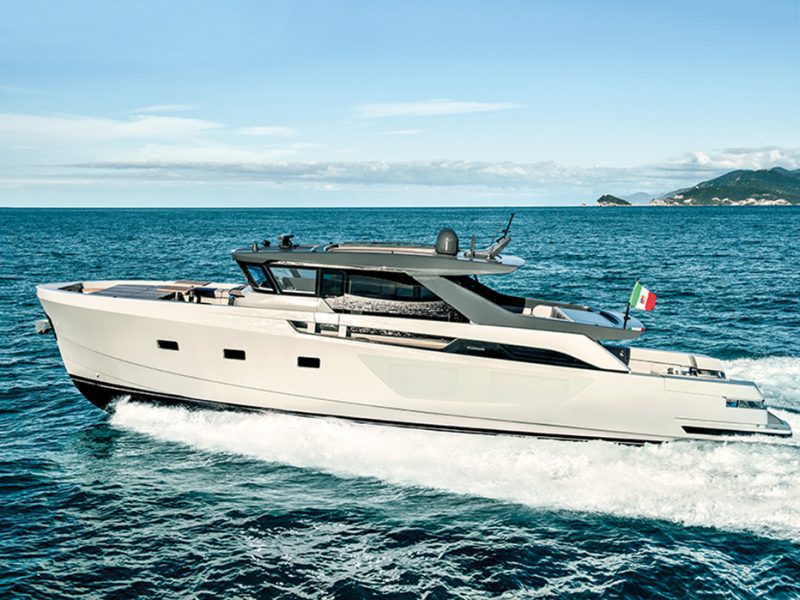
The Bluegame BGX70 stands out for its innovative stylistic and functional language. It has excellent nautical characteristics and tackles the sea extremely efficiently
by Francesco Michienzi
DESIGNERS ALWAYS HAVE A NIGGLING WORRY AT THE BACK OF THEIR MIND THAT THEY MIGHT FAIL TO CREATE SOMETHING BEAUTIFUL. Since there are so many restrictions when designing a boat, the result does not always match the client’s expectations. With functionalism, rejecting any form of creative freedom or architectural invention can often end up being a complex process with no shortage of risk. However, the Bluegame BGX70, designed by Zuccon International Project, is the exception that proves the rule. This craft goes way beyond the standard vocabulary used to describe a boat’s design, beyond the usual cold and repetitive terms; the originality and functional coherence cannot be expressed in linguistic terms, as the designers have managed to bravely enter into a world of dreams and fantasy.
Martina and Bernardo Zuccon spent over eighteen months on the project, based on a concept developed by Luca Santella. Bernardo told us: «Following a discussion with Luca, we realised the time might have come to venture into unexplored territory by combining a whole host of experiences related to life at sea. The main aim was not to restrict ourselves to a set path, but to try to work out whether we could create the best possible relationship with the sea in a single product. I find the BGX70’s connection to the sea clearly apparent, visceral and profound».
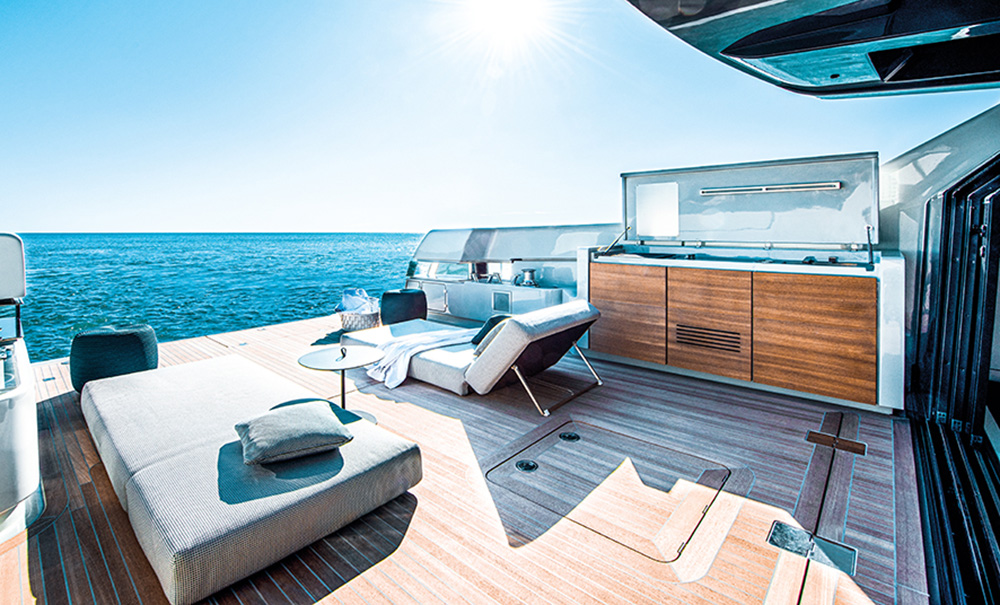
We ask Luca Santella what the boat’s strong points are, and why someone should buy it. «There are a whole host of solutions on board that make it unique on the market at the moment, combining the advantages of the old Bluegame yachts, the latest-generation boats and the Sanlorenzo XSs. I’m referring to the beach area at the stern, the open spaces at the bow, the connection with the sea and the fact you are always close to the water. But this boat goes further, because all these advantages mean that you also get the feeling of being near the sea from inside the boat. When you’re in the sitting area, you can stay in contact with life outside on the beach, and you have an exceptional view to the sides; you’re not in a room with big windows, you’re in a living environment, which you are sharing with whoever is having a bath or smoking a cigar at that particular moment».

This is undoubtedly the result of careful design work, as Bernardo Zuccon reveals: «The most enthralling challenge was combining all these different types of craft, in the sense that most work was done based on the longitudinal section of the boat. Martina and I worked on an extremely complex optimisation process, to try to give the interior an attractive appearance, a result that would be neither something different, nor necessarily provocative, but part of a timeless language that does not become dated. Optimising each space on board, even the smallest areas, was crucial, because we had to include more functions than would normally be provided on a boat of this size».
Martina adds: «One of the first things we did to optimise the space was to position the engine room right at the stern, thanks to the Volvo Penta IPS propulsion system. This meant we could get the best out of the stern area by positioning the lower deck saloon there. I think this is the most beautiful part of the boat; it offers the closest contact with the sea, as you are at the same level as the water. It is a combination of various elements, where the engineering component and architectural component have come together to create a unique result».
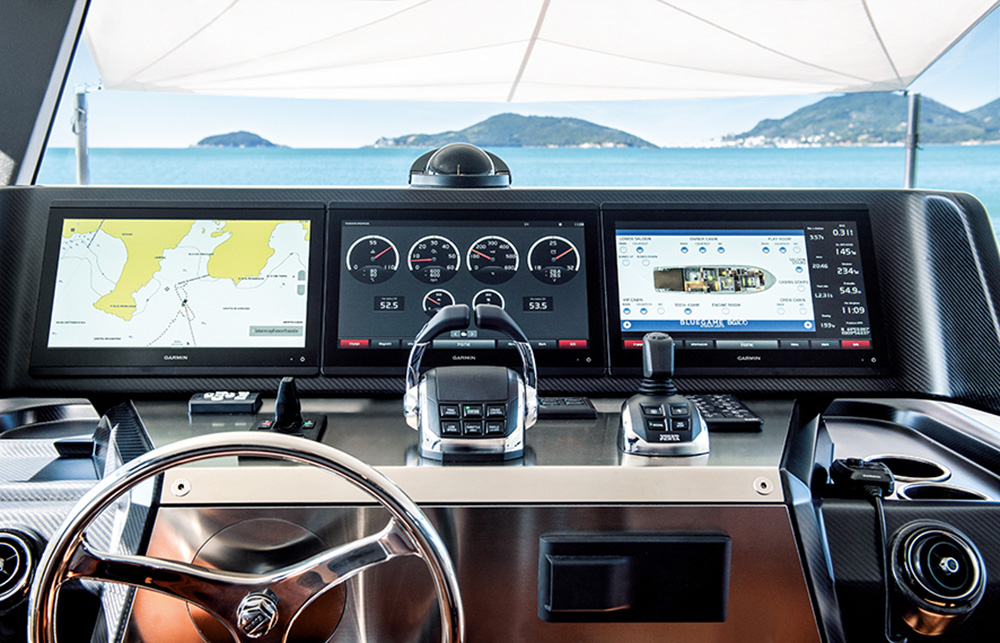
All navigation systems are handled through an integrated Garmin GPSMAP 8400 dashboard with a touchscreen display. The dynamic positioning system (DPS) ensures the boat does not stray from the desired course.
We tested the Bluegame BGX70 in a sea with long waves and the remnants of a Libeccio wind, blowing at 9 knots. The yacht has two Volvo Penta D13 engines, 1,000 hp each, with an IPS 1350 system. The conditions were not impossible, but certainly not comfortable. We set off from the jetty at Marina di Carrara and head towards the open sea, pushing down the throttle as soon as we emerge. The boat accelerates gradually: in thirteen seconds the hull is out of the water, and it takes another 22 seconds to reach top speed. The GPS displays an impressive 29.5 knots. The power distribution is very regular, with no dips or jerks. The handling is also well balanced, as is its manoeuvrability at full speed. The two IPS 1350 engines have been tuned specifically to avoid overly tight turns. Visibility from the single helmsman’s station is excellent. The glass windscreen is sloped like a professional fishing boat, designed for long journeys, and can tackle the most challenging sea conditions at all times of the day and night.
All navigation systems are handled through an integrated Garmin GPSMAP 8400 dashboard with a touchscreen display. We plane at just 100 litres/hour, and only reach 384 litres/hour at full speed. Not bad considering we are on board a boat that is over 21 metres long at its longest point and has a displacement of over 43 tonnes when fully loaded. Given that the power/weight ratio is roughly 21 kg for every horsepower available, there is no doubt we are on board a well-built boat, with excellent balance and a very efficient hull. The waterlines were designed by Lou Codega, an American designer who specialises in ultra-high-performance hulls. The boat has a variable-shaped hull with a very deep V.
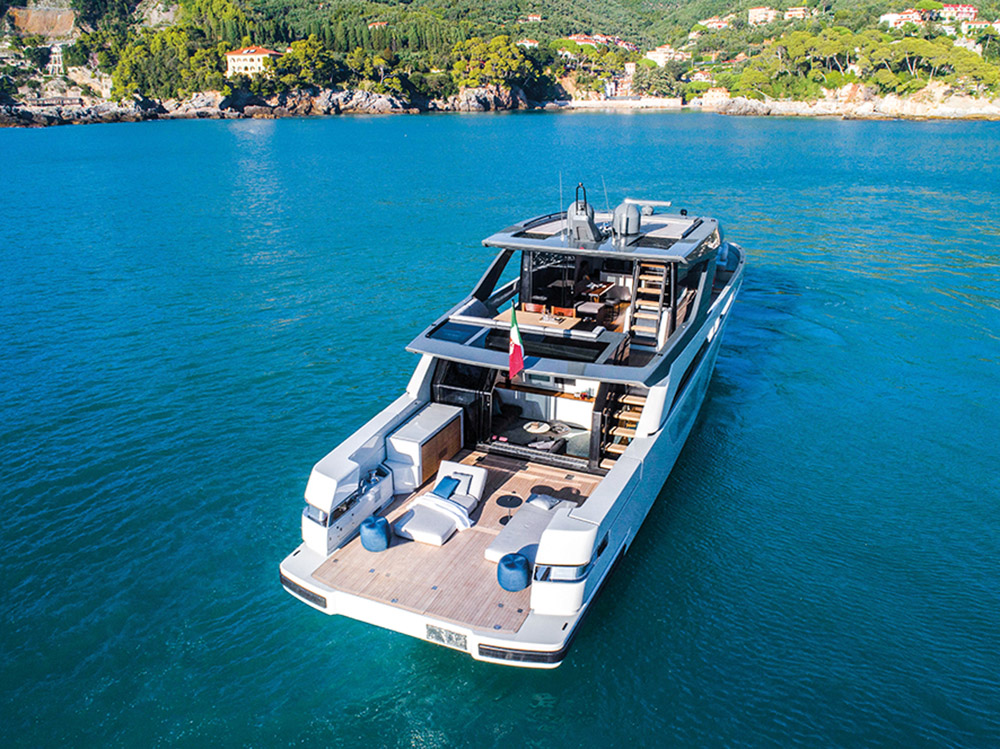
The Bluegame BGX70 stems from work by a team of top professionals who, coordinated by Luca Santella, have created an excellent seafaring boat. The hull is made using a mould, and has a laminated block and sides and structural bulkheads made of sandwich composite, all laminated with vinylester resin. The same procedure is followed for the bridge and the deck, which are also made of sandwich composite and vinylester resin. There are some carbon fibre components in the console and in the seats, which match the rest of the Bluegame range. The lamination – the application of layers of composite materials – is carried out using vacuum infusion.
Codega’s boats have always had a high degree of variation in the deadrise between the bow sections and the sections at the stern, where the angle reduces dramatically. This creates a craft that performs impeccably in choppy water, but which can also plane at low speeds, and so guarantee full control of the boat even in truly extreme conditions. This type of hull also provides excellent performance with limited power, and therefore reduced fuel consumption.
Engine room
The Volvo Penta D13 engine and the IPS 1350 propulsion offer the dual advantage of ensuring more indoor space and offering better manoeuvrability. The maximum speed is around 30 knots, consuming 385 litres/hour.
BLUEGAME
Via Marina di Levante, 12
I-55049 Viareggio, Italy
T. +39 0584 395 334
[email protected]
www.bluegame.it
PROJECT: Luca Santella (concept) • Zuccon International Project (design) • Lou Codega (naval architecture)
HULL: Length overall 21.86m • CE certificate length 20.80m • Maximum beam 5.60m • Draft @full load 1.60m • Light displacement (estimate) 38.0 t +/- 5% • Full load displacement (estimate) 43.0 t +/- 5% • Fuel tank volume 4,200 l • Fresh water tank volume 1,330 l • Waste water tank volume 300 l • Grey water tank volume 300 l
MAIN PROPULSION: 2 x D13 1,000 hp, IPS Volvo Penta 1350 • Max speed 30 knots +/- 5% • Cruise speed 27 knots +/- 5%
EC CERTIFICATION: CAT B • Max num. passengers 16
PRICE: 3,350,000 € as standard, Excl. VAT
(Bluegame BGX70, one of a kind – Barchemagazine.com – April 2020)