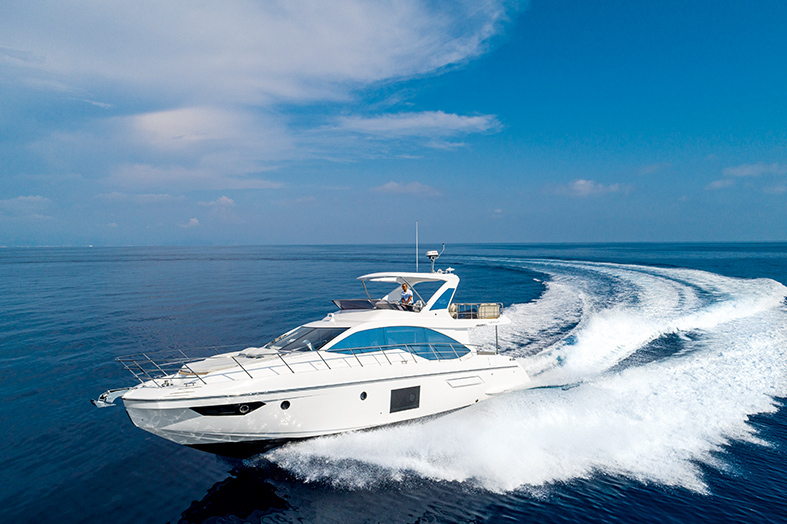
Not too much noise, good performance and easy to handle, but comfort is the main impression you get from both the interior and the exterior of the new Azimut 55 Fly designed by Stefano Righini
by Niccolò Volpati – photo by Matteo Borzone
Fifty-five feet is a length that sits on the boundary. Until just a couple of years ago it would have been unthinkable to helm a sixteen-metre ship without a sailor. But that can be done nowadays. You need an owner who is more than just a beginner and – most of all – you need a boat that is easy to manoeuvre. That is what the yard has concentrated its efforts on, so that anyone who wants can handle the Azimut 55 Fly even without crew.

In the engine room there are two 800 hp MANengines, with in-line transmissions. We are on a boat with a flybridge, a boat that represents the essence of the tradition. There is almost nothing to invent and the solution with the in-line tran smission has worked out well. The feeling at the helm is that of having a very balanced power unit. It doesn’t jerk, either when we try to suddenly open the throttle right up, nor when we slow right down. Everything has been looked at to make it comfortable and easy to handle.
There are no excesses and as a result there aren’t any mistakes either. There is a little bit of help to sail the boat properly, which come from the Zipwake interceptor. When I was at 1,600 rpm, just past planing level, I put it into automatic mode. Without touching the throttle, the speed immediately increased from 18 to 19 knots. Interceptors are distinctly better than me at adjusting trim. And the advantage can be seen on the screen of the GPS device, which shows an extra knot of speed, and less fuel usage. Even though you may think you are very good at it, I recommend that you let it work automatically, so you can concentrate on something else because the trim will always be the best possible.
As you increase speed, performance and consumption increase. At top speed we did over 30 knots, and used 300 litres an hour. The ideal level is, I think, at around 1750 rpm. You go at just under twenty knots and you need eight and a half litres to do a mile. Not bad, considering you’re on board a sixteen and a half metre boat, which weighs nearly thirty tonnes.
The advantage of Zipwake interceptors can also be felt when you turn. And even when you are turning as much as possible, the boat doesn’t tilt very much. The boat always stays level thanks to one of the two blades that resists tilting. When you turn left, the interceptor works right, and vice-versa. It feels nearly like being on a trawler or a catamaran. The level of comfort is notable, especially for guests on board. The only problem is that you lose a bit of speed. In a tight turn, for example, we slowed from 22 to 19 knots. The interceptor is a blade that goes down into the water, and keeps the boat flat, but despite that is still a submerged attachment that creates resistance.
But how does the Zipwake know that we are turning? Amongst the sensors included in the system is a gyro compass that registers the rate of turn and tells the interceptors to work to keep the hull as horizontal as possible. But when you steer straight ahead, the speed is left unchanged. The electronics applied to steering the boat means that you can also customise the sensitivity of the steering. As with other Azimut models, the 55 Flyoffers a different sensitivity to the one used for changing course.

For example, during harbour manoeuvres the steering is very sensitive and the boat becomes particularly easy to manoeuvre. But when under way, you have to steer more decisively to turn. That is all aimed at making it easier to handle the boat. It is a bit like having a car with power steering. As well as an engine that is regular and progressive in its output, automatic trim and turning that is done nearly without tilting, the levels of comfort while underway can also be felt by the lack of noise.
Both at the dashboard and in the owner cabin, which is closer to the engine room, there aren’t a lot of decibels registered. You need to be at full speed for the noise levels to exceed 80 dbA in the cabin, and even at thirty knots you only just get over 70 decibels. So the soundproofing in the engine room is extremely good, and that also leads to feeling comfortable when under way.
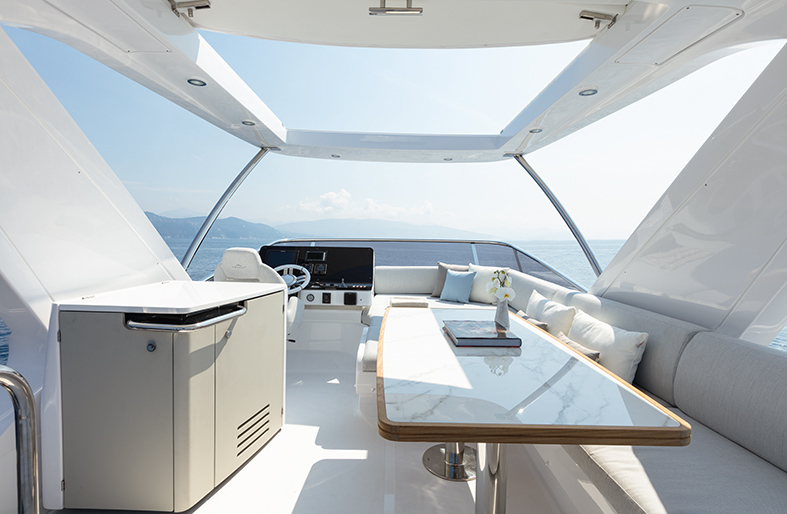
The Azimut 55 Fly interiors made a positive impression on me; they certainly make you feel you are not on an average boat. Perhaps that is because of a number of small touches like lamps, the choice of colours, materials and the fabrics. There is quite a variety of them, but they are put together intelligently. The interiors of the 55 Fly are elegant and refined, but most definitely unique. And it isn’t unique just through a few bold decisions made simply for flamboyance sake. It isn’t appearances that make this boat different, but its feel
AZIMUT YACHTS
Via Martin Luther King 9/11
I-10051 Avigliana (TO)
T. +39 011 93161
www.azimutyachts.com
AZIMUT 55 FLY
PROJECT: Hull design Pierluigi Ausonio • Naval architecture, exterior designer & concept Stefano Righini • Interior design Achille Salvagni
HULL: LOA 16.90m • Length 16.50m • Waterline length 14.10m • Maximum beam 4.90m • Draft 1.50m • Displacement 29,000 kg •Fuel tank volume 2560 l • Water tank volume 590 l • Waste water tank volume 175 l • Grey water tank volume 175 l
MAIN PROPULSION: 2xMan i6-800 • Outlet mechanical power 558 kW (800 hp) • 6 cylinders in line • Bore&Stroke 126mm x 166mm • Swept volume 12.42 l • Maximal rotational speed 2350/min • Dry weight 1,215 kg
EC CERTIFICATION: CAT B
PRICE:1,100,000 €, Excl.VAT
(Azimut 55 Fly, a question of FEELING – Barchemagazine.com – December 2018)