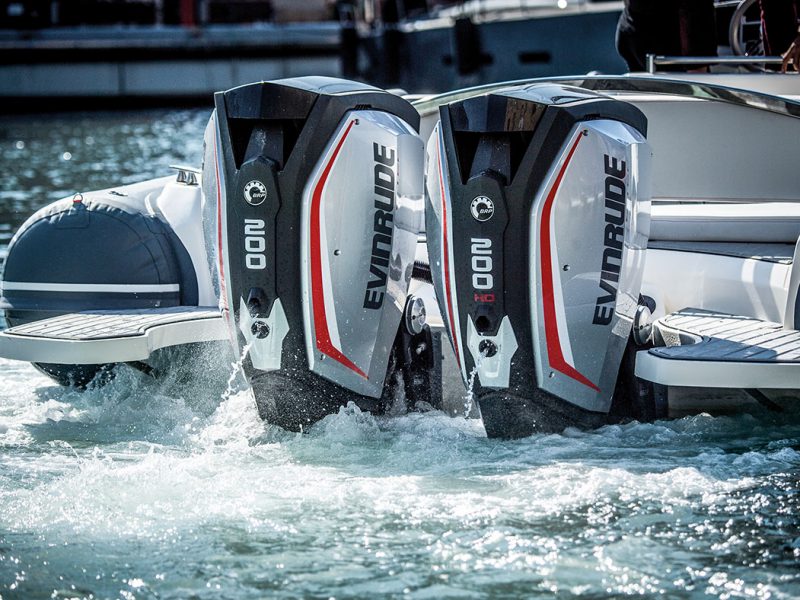
Some thought that two-stroke direct injection outboard engines were destined to end up in the attic, but in reality, they are very much alive and strongly competitive, as the second generation of the BRP Evinrude E-Tec G2 clearly shows
by Niccolò Volpati
There was a time when all evils in the world seemed to be caused by the two-stroke engine. Global warming, the hole in the ozone layer, and tropical cyclones were all disasters attributed to two-stroke outboard engines. And shame on those who produced them and anyone who insisted on using them. So, all global regulations seemed to be conceived to force manufacturers to move on to the greener four-stroke.
Evinrude chose not to adapt to this change. It had a two-stroke direct injection engine and chose to focus on developing what it had. In the beginning, things were not easy; the company even went through times of serious difficulty. From OMC it then became BRP, and from the notorious Ficht Rams it moved on to the E-Tecs, the very first engines produced under the old OMC management and the new ownership. Several years ago, a mechanic told me that Evinrude’s Ficht Rams were like Soviet MiGs, the military fighter aircraft. The situation with the Ficht Rams was similar; they were often in the workshops for outboard engines because this type of engine gave shipowners and mechanics so many headaches that they had to start grappling with after-sales service.
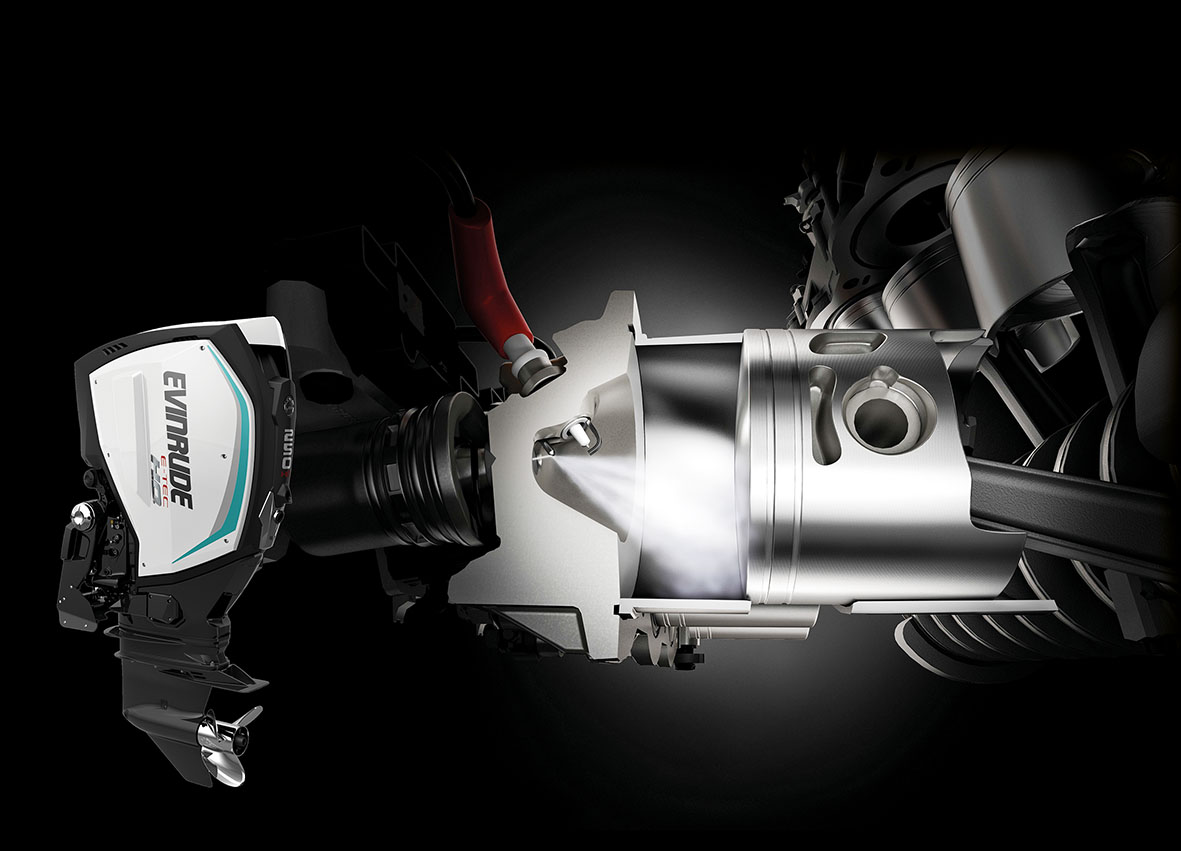
Luckily, BRP decided to proceed with the development of two-stroke direct injection engines and put Evinrude’s engineers to work. The goal was to make an outboard engine that could comply with the strict anti-pollution regulations, particularly in the United States. This is how the modern E-Tec was born, which has reached its second generation today. How did they succeed in creating a green two-stroke?
The E-Tec engine has no oil in the petrol. Only pure petrol flows through the high and low pressure pumps that insert the fuel into the tank. The oil is still there, obviously, because it is still a two-stroke, and it is consumed in a ratio of about 1.7-1.8% over the petrol. The difference is that the oil is not mixed because it goes directly to the rotation points like the pistons, and in general to the areas with the highest level of friction.
Since the engine does not mix, the oil that flows into the exhaust has not been combusted and is consequently much cleaner. And where does that oil go? A good part of it burns by friction and another part goes into the ports and then into the exhaust. It is no coincidence, in fact, that the level of pollution caused by the E-Tec G2 is as much as 75% lower than that of other outboard engines still in use. These measurements are issued by the EPA, so there is no way around it.
The measurements of air pollutants are performed on marine engine exhausts the same way they are performed on cars. About one and a half years ago, even stricter regulations for marine engines entered into force, which the E-Tec G2s fully comply with. For this second generation of E-Tec engines, a specific software was developed called pure power combustion, which helps provide all the fuel necessary for combustion, and not a single drop more.
If the engine needs one liter and a half, the combustion chamber should hold 1.5 liters and not 1.7. In this way, emissions can be reduced even further because there is no unburned gasoline, the engine is even cleaner and more efficient, and consumptions go down. Compared to the previous generation of E-Tec engines, this one, i.e. the G2 single-block engine with 150, 175 and 200 hp, consumes about 15% less. We were able to witness that when we tested them. The figures on the flow meter were always very comforting.
Also in absolute terms, and not only compared to the old two-stroke engines, Evinrude’s E-Tecs have decidedly more contained consumptions. Many four-strokes on the market are not able provide a similar performance. And then there is the torque. How did Evinrude’s engineers manage to improve it so much?
Their G1 engines – that is, the “old” E-Tecs – had exhausts that converged inside the motor unit. In the G2, on the other hand, they are opposite each other. The converging exhausts, in fact, had the drawback that they made the pistons work on hot walls that could reach temperatures as high as 800° Celsius. At high temperatures, the risk was that the engine could be damaged even after a short time. 50 hours of navigation could be enough to find yourself in the middle of the sea with a burnt-out engine block. To avoid this and to extend the life of the engine, Evinrude used to reduce the torque. And the more power they gave the engine – with the 300 hp, for instance – the more did they have to reduce the torque.
The result was a paradox: a very powerful engine with a low torque. G2 engines do not only have opposed banks, but they also feature a longer connecting rod to put less strain on the wall. These solutions cool down the walls and the torque can consequently be pushed to its limit. Moreover, in order to further lower the temperature and increase the torque, the silencers are jacketed and are cooled down by the passage of water.
So the water first of all lowers the temperature of the cylinders, but it also cools down the exhaust pipes. All these changes have produced an obvious result: the two-strokes are no longer an endangered species and the advantages are clear to see for anyone who has had a chance to try them: a lot of torque, great acceleration, enhanced power, low emissions and low consumptions.
BRP Range
The most recent single-block engine is the one providing 150, 175 and 200 hp. It is a V-shaped 6-cylinder engine with a bank angle of 66° and a 2.7 liter displacement. The most powerful outboard engines, with 250 to 300 hp, also have a single-block V6, but with a bank angle of 74° and a 3.4 liter displacement. The range also extends to a lower segment. The middle segment includes outboard engines with 75, 90, 115, 130 and 135 hp. Finally, the smallest E-Tecs range from 25 to 60 hp.
Accessories
The hydraulic steering system is integrated so it has unparalleled maneuverability. Evinrude also offers electronic throttles and i-Trim and i-Dock systems. The former is for automatic regulation of the set-up and it is part of the standard set-up on all new outboards, while the i-Dock is the berthing joystick, which, obviously, is an optional feature. Finally, the Evinrude app, ilink, provides users with all the motor data directly on their smartphone and tablet.
Maintenance
The warranty covers 5 years or 500 hours, so it is easy to see that BRP is fully convinced of the reliability of these engines. No break-in period nor oil change are necessary, an average of 50 hours running time on one oil canister.
(BRP, alive and kicking – BRCHEMAGAZINE.COM – Luglio 2018)