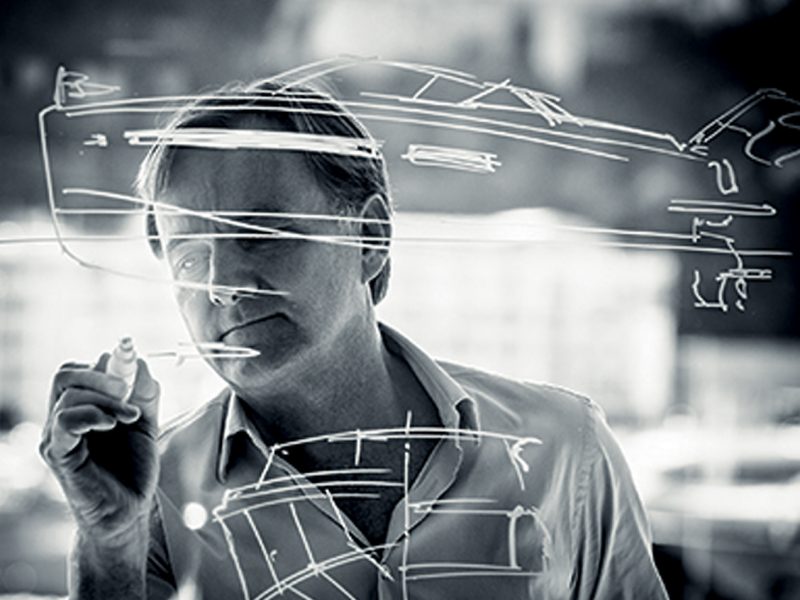
Norwegian, he is known as a boating archistar, graduated in naval architecture and engineering he started working with Martin Francis and in 1994 he opened his own studio
by Andrea Dini – photo by Guillaume Plisson
INTERVIEWING ESPEN ØINO IS CERTAINLY NOT SOMETHING YOU GET TO DO EVERY DAY. The open space in Monte Carlo where his team works on several projects simultaneously, obviously overlooking Port Hercule, is without doubt one of worldwide yachting’s most important “workshops”. The computer screens show pictures of luxury mega yachts and their details, and seeing the whole team working on projects in absolute silence is like watching a group of artists concentrating on creating something unique, something that will leave a mark. This is where many of the most important mega yachts launched in the last 15 years were developed. Espen Øino’s occupation is more of a lifestyle than a profession, continuously sharing knowledge in order to create what can without doubt be defined as works of art, single edition masterpieces. “Sharing” with clients means understanding their tastes, passions and ambitions, and being able to “materialize” these into a mega yacht requires a huge baggage of knowledge and experience. Designing a mega yacht today, knowing that it will take at least five years before it will be completed and used, means having a “vision” for future tastes, trends and technology in order to create something long lasting. A whole issue of BARCHE would not be enough to use words and pictures to describe everything that came out during the conversation with the volcanic and histrionic Espen. His personal studio is clean and minimalist, reflecting his personality, although the real treasure is hidden in the secret library located just behind his back. Books that cover the entire history of yachting, and which Espen scoops up by the armful to illustrate each concept as he talks. Most of all, it is amazing to see him drawing and sketching to create something that takes the typical shapes of his boats… whether it’s on a sheet of paper or a glass table… you realize that in the end, the shapes of his “creations” flow exclusively from his hands.
How has yacht designing changed, compared to 20 years ago?
To illustrate his first answer, he “plunges” into his archive and takes out a photo of a young Espen, sitting at the drawing board in Martin Francis’ studio almost 30 years ago, along with some others from when he worked in Norway. “We used to work in 2D while now the modeling is in 3D. We only developed a few perspective sketches of each project, because they took a lot of time to draw.” There used to be a lot of space for dreams and imagination – nowadays, technology allows us to get a view that is so in-depth that it’s nearly real. You can already see and experience each area of a boat. Once the 3D modeling is finalized, you can start the rendering and animation phases. We don’t do 2D designs anymore, we model three-dimensionally. My staff is almost entirely dedicated to modeling. Today, you just have to change one parameter and the whole project changes; in the past, every change meant starting all over again”.
Are there any essential style elements that were very different to each other, but which have now gone out of fashion?
It’s like fashion…trends and styles come and go in cycles. Just look at bows: over eighty years ago, and right up to World War II, they were almost all vertical. The development of pleasure yachting has stretched bows, maybe to enhance the feeling of desire and set them apart from transatlantic ships. Some items of clothing that we were wearing 20 or 30 years ago have come back into fashion; for instance, Moncler quilted jackets, which are once again in fashion. Sterns and the position of the tenders have changed a lot more. For example, today there is the trend to position the tender inside the boat with the opening towards the stern or to the side – things that were previously unthinkable and today are considered normal. Consequently, the access to a yacht has also changed. Stern platforms and large convertible garages allow yachts to be used in new and different ways, with a new concept and interpretation of the whole stern area. Yachts are now bigger and higher and this has also changed the way they interact with the water. Many areas of modern mega yachts are farther from the water, making it necessary to create new areas to recreate the link with the water and outdoor living areas. The beach club areas are definitely one concept that has been developed in recent years. “Princess Mariana”, built by Royal Denship, was one of the first yachts with a real beach club. Then we made the “Octopus” with some similar elements, but with a much larger garage, able to host an 18m. tender and a submarine. We worked a lot on this concept together with the owner (Octopus was delivered to Paul Allen, co-founder of Microsoft, in 2003 ed.) since the initial designs from 1998-1999.
You are a specialist in mega yachts, and you are used to working with very successful men. How do you relate to them?
I think there is nothing special, except being natural and above all being yourself. The amazing thing is that when you talk about boats with these people, you are talking about something they are interested in, something that is linked to their personal life and leisure time, their hobbies. They like to talk about it and they are enthusiastic. You don’t necessarily see their business side. When you have something in common to talk about, it’s easy to find a way to communicate, because both of you share the same passion. They are the ones who are finding time for you, cutting it out from a busy schedule as a priority, and this leads you to meet them and spend time with them in particular and unexpected situations. Sharing the creative design process with the owner is a fundamental step in developing the project. You can establish a special relationship…otherwise it would be difficult to design their mega yachts.
How do you deal with the different cultures?
It is fundamental to establish a clear brief when starting a project. Certainly designing a yacht for a Middle-Eastern owner is different from doing it for a North American or Scandinavian one. For us, it is essential to read up and learn about the culture of the people we will be working with. We have designed yachts for American, European and Middle-Eastern customers and we have just started designing some projects for Chinese clients. They have different priorities to our own, so it is a new learnin g process. They expect the designer to know their culture. Especially in terms of the functionality and use of the different spaces onboard. For a certain period, you almost have to live with them in their day to day environment in order to fully understand their tastes and needs. My being so “open” to the world has certainly allowed me to better develop this aspect of my personality and professionalism. I am also sure that most of the mega yacht owners know each other and spend a lot of time together.
Which was your favorite project?
One very important project for me, during the transition to new technology and software, was certainly “Skat”. We built this boat for Charles Simonyi, who developed software like Microsoft Excel, a mathematician with an absolutely brilliant mind. It was very important for me to understand and study his house in Seattle, which was a huge inspiration for us. There was a predominance of glass windows, angles and straight lines, and the color grey. So we went right from the first sketches, which I always do by hand, to computerized modeling. It was 1999 and the software wasn’t so advanced and fast yet. The boat was delivered in 2002, and it really caused a stir, and attracted a lot of different opinions. There Is a key word in every project and in this one it was “real”, “honest”, meaning that we used the materials exactly as they were produced, without modifying them. The owner, being a mathematician and super logical, told me: “Espen, I don’t understand why all these boats look like curved pieces of cheese. They are built of steel and aluminum and they have a very complex shapes. For me, steel and aluminum are flat, linear products, and I would like to see this reflected in the design so that the form and contents match. Of course, some parts, like the bow and the stern, are more complex, but I would at least like the superstructure of the boat to be straight, linear and clean”. It was a real challenge, and building it with the Lürssen cousins Peter and Friedrich was also interesting. When the yacht came out of the shipyard, Friedrich, the elder cousin, told me: “I thought this was going to be the ugliest boat we had ever built at our shipyard, but it is completely different from how I had imagined”. This boat was a revelation. Many of the people who initially criticized its design liked it afterwards, and it became one of the most iconic boats until a couple of years ago. This project was particularly important to me. The owner would come to the shipyard every 5\6 weeks directly from Seattle with his private jet, spend the whole day with us and fly back the day after.
Is there any particular element of your design that defines you as a designer, and could let us say “This is clearly an Espen Øeino yacht?”
Perhaps, with the exception of Silver Fast, a characteristic of my boats is the linear design, and the windows to the fore that look straight out, as if to dominate the sea. I like lots of light and space. I am above all an engineer, so I have a love of “logic”. A yacht design is made up of vertical and horizontal lines. The distance between the horizontal lines is more than between the verticals. This is the simplest way to make the windows as large as possible whilst retaining the best structural integrity. It Is important to always be able to see the surface of the sea when you sit inside a cabin.
Apart from Ester III, whose bow is almost vertical, the other boats you have designed all have classic bows. Is this a coincidence, or is it a conscious decision that vessels made for demanding cruises shouldn’t have a straight bow?
A lot of it has to do with the client brief. Then there are some important factors, like the fact that a straight bow lengthens the waterline making the hull more efficient in terms of water resistance. It’s more economical at high speeds, although I don’t think this is really an important issue for these yachts; it is more of an aesthetic choice. Vertical bows are certainly more exposed to sea spray because they “deflect” the action of the water less.
Is there any dream boat you would like to receive an order to build?
I am fascinated by cruise liners and I am very sad to see how they are designed today. I would like to design one, not necessarily a large one, but with a project in line with my ideas and culture. The first cruise ships had long and elegant lines, with small superstructures, and today they are all the same, massive and with squat shapes. I’d really like to redesign cruise ships with new lines.
Have you ever thought of designing more small boats? Was Velcro Fish just an exception?
No, Velcro Fish was not just an exception. The boat is still being used and the client is a friend of mine. We are designing several tenders for our big boats. I love to design small boats, more and more.
But something more “commercial” not linked to the single request for a tender?
(The answer was short and brusque): We are working on this with a European shipyard and soon there will be big news. Just stay tuned.
But don’t you think that your design could become too expensive and not successful on the mass market?
High end product whether in real estate, cars, yachting, private planes, jewels, watches wherever seem to be more recession-proof. In this type of market segment you do not need big numbers; you need to reach the goals you set. For me, it is a completely different story, because it changes the relationship between the owner and the boat a lot.
(Close encounters, Espen Øino – Barchemagazine.com – January 2016)