With the new Seadeck range, Azimut has decided to focus on sustainability. Based on an ecological, eco-conscious and responsible ideal, the boat opens up to the sea – and to the market – to offer new, immersive and lifestyle experiences
by Sacha Giannini
With open areas and transparent sections, engines, energy and comfort, the Seadeck 6 overcomes resistance and fuel consumption by embracing a holistic concept in which boat, body, mind and spirit come together to connect, rethinking both the expressive and passive potential of the boat. The shape, the hull, and the materials become the main protagonists in a type of eco-boat that is balanced in the integration of solutions and active systems fed by the sun, the wind and the sea. From a purely aesthetic point of view, the shape is developed by eliminating the superfluous, the extra, the excessive. By interpreting the lessons of the founding fathers of modern functionalism, Azimut focuses on style, comfort and fuel consumption, following a “less is more” philosophy, respecting the sea, its essence and its spirit. “Empty your boat, make it lighter. Give up passions and hatreds to sail towards freedom”, Siddhārtha Gautama Buddha.
On the one hand, we have the sea, a mystical place that is not a place, the perfect environment to challenge nature and rediscover yourself. On the other hand, we have boats that are constantly engaged in mediation between comfort, performance and perception. Once again, Azimut has found the right balance between form, structure and function in a design capable of interpreting the spirit of the times at the level of the user, far from virtuoso bravura or overly artistic performance. Without any major contradictions, beyond those imposed by the market and some current trends, the skilful use of volumes and light shows the clarity of the construction of the whole, the contents and the container.


Warm and intimate lighting play a fundamental role in the project, and in order to create an original interpretation of light and shade, Matteo Thun and Antonio Rodriguez chose to clad some of the walls with canned oak panels, a material that not only lends intensity to the surfaces but also contributes to the yacht’s durability, as it is scratch-resistant and has a longer lifespan. The quillboarding echoes the play of light and shade created by the brise-soleil on the canopy.
Design sustainable yachts
With the high quality of the hull, the topsides and decks, simplicity is at the heart of everything. Thun & Rodriguez, Mancini and the Names design studio, coordinated by Azimut’s R&D department, know that sustainability cannot be ignored. And they know that working with the sun and the sea means much more than just building boats without windows or with a mild hybrid electric system. Instead, it means looking again at conscious actions and where construction issues are no longer at odds with healthy, ecological building principles. And it is not just about wood and oars. The mass, inertia and weight of materials have been progressively reduced through a combination of lightness, transparency, immateriality and shapes. Nearly 40% of the Seadeck 6’s surface area is laminated with carbon fibre (superstructures and deck) to optimise weight, fuel consumption and emissions. The planing hull has a deep V that widens aft and is more fluid in the bows, allowing it to plan at lower speeds. Solar panels integrated into the structure power onboard systems for up to eight hours at night and four hours during the day. The pod’s propulsion units use a light hybrid Volvo Penta thermal diesel engine, which is expected to reduce CO2 emissions by up to 40% in an average year’s use, both at anchor and underway.
Interior designers Matteo Thun and Antonio Rodriguez believe that “conscious design is driven by a vision of living more humane, natural and sustainable”. For Seadeck 6, they proposed a linear design language that enhances the perception of space and the use of natural or recycled materials to ensure a conscious use of natural resources.

There are more and more boats on the international stage that profess to be sustainable, but that is often because of principles and an approach that has to do with the competitive environment. That is why buyers don’t always find much real evidence of sustainability onboard, except for a bit of integrated technology or in the reuse of reassuring entirely recyclable material. Azimut has surprised the world market and is trying to immerse people in a new boating dimension, with crafts that are open to the sea with a technologically-controlled system, transparency in information, and are trusted in terms of performance while being responsible for the consumption of environmental resources.

The lower deck is lined with carpet made from recycled and infinitely recyclable raw materials. The result is a pleasant, silk-like feel and an example of how design can provide an environmentally friendly solution for flooring.
With all due respect to the objectives of the Kyoto Agreement and other similar good intentions, the Seadeck series tries to think of the future, of ethical consumption and psycho-physical well-being. Azimut is also looking for the right materials and, with an ecological impulse, is using as much recycling as possible. Instead of the PVC still used on many topsides, the bulkheads and the deckhouse are made of sandwich panels with a core of expanded PET foam made from recycled materials such as bottles. Although covered with traditional “skins” of frosted glass impregnated with epoxy resin, the PET sandwich technique increases the load-bearing capacity and reduces the weight, improving both the sailing experience and fuel consumption, especially at the best cruising speed of between 22 and 24 knots. The soft furnishings and interior fabrics are made from natural fibres, the carpeting on the lower deck is made from nylon recycled from fishing nets, the Mediterranean cork that covers the deck is peeled from the trunk without cutting down any trees, and the light oak slices that cover the bulkheads on the main deck come from responsibly managed forests certified by the Forest Stewardship Council (FSC).

SACE COMPONENTS’ MARINECORK HAS BEEN USED TO REPLACE TRADITIONAL TEAK FOR OUTDOOR FLOORING. IT IS A 100% NATURAL RESOURCE THAT CAN BE HARVESTED MULTIPLE TIMES WITHOUT DAMAGING THE TREE AND IS LIGHTWEIGHT, FIRE RESISTANT AND WATERPROOF.
With all due respect to the objectives of the Kyoto Agreement and other similar good intentions, the Seadeck series tries to think of the future, of ethical consumption and psycho-physical well-being. Azimut is also looking for the right materials and, with an ecological impulse, is using as much recycling as possible. Instead of the PVC still used on many topsides, the bulkheads and the deckhouse are made of sandwich panels with a core of expanded PET foam made from recycled materials such as bottles. Although covered with traditional “skins” of frosted glass impregnated with epoxy resin, the PET sandwich technique increases the load-bearing capacity and reduces the weight, improving both the sailing experience and fuel consumption, especially at the best cruising speed of between 22 and 24 knots. The soft furnishings and interior fabrics are made from natural fibres, the carpeting on the lower deck is made from nylon recycled from fishing nets, the Mediterranean cork that covers the deck is peeled from the trunk without cutting down any trees, and the light oak slices that cover the bulkheads on the main deck come from responsibly managed forests certified by the Forest Stewardship Council (FSC).
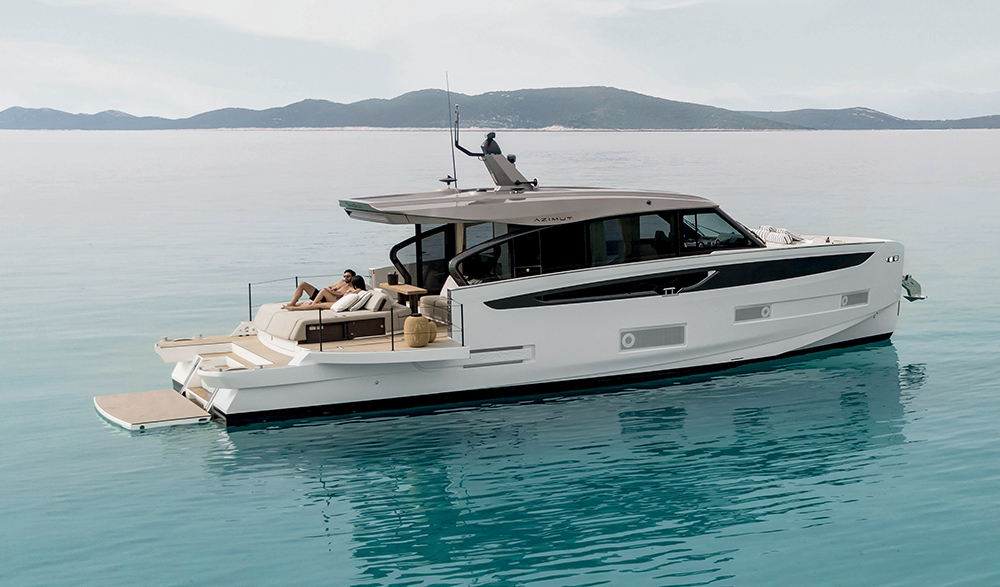
Seadeck 6 embraces the sea on all sides, creating an immersive experience that invites you to rediscover an authentic and profound contact with nature. In this way, barriers between guests are broken down and the deck becomes the heart of life on board, creating opportunities for interaction between those who sit inside, those who enjoy the sun outside and those who dive into the water.
How’s the Seadeck 6 from Azimut Yachts doing?
We tried out the Seadeck in the waters off Fano harbour, with eight of us on board, 890 litres of fuel out of a possible 2,400, 370 litres of water and 115 litres of sewage and wastewater. That gave a total of around 1,800 kg of load in addition to the 27-tonne displacement. The conditions, with a variable wind of five knots and a flat sea, were favourable for trying out the top and ecological cruising speeds, but rather less so for a sea-holding test – which we nevertheless did do by turning fast and cutting through our deep wake, and the boat stayed balanced and safe. At 1000 rpm and 6.3 knots, she burns 12 litres per hour or just under two litres per nautical mile. If we increase this to 1500 rpm, she speeds up to nine knots SOG, using 32 litres of fuel per hour. The progression is therefore clean and quiet, with the engines responding quickly to an imminent and perceived pre-planning phase. At 2000 rpm, the speed quickly rises to eleven knots, consuming 74 litres of fuel per hour – in practice, this means that just under seven litres of fuel were needed to move almost thirty tonnes one nautical mile. At 2500 rpm and 15.5 knots, the engine consumed 125 litres of fuel per hour, with a fuel consumption ratio that was virtually flat from that point on. We reached the best ecological cruising speed of 22 knots at 3000 rpm and also reached 3750 rpm and 287 litres per hour, with a top speed of 32.5 knots, with a fuel consumption of between 8 and 8.8 litres per nautical mile. It is very quiet on board, both inside and on the fun island outside, and looks good and elegant on the water, with plenty of light, visibility and comfort, even at 32 knots. It is a polite boat, but also a very sporty one, suitable for families and anyone who wants to sail in a more healthy and environmentally conscious way.

Sustainability and boating
The fibres and resins of tomorrow may be inspired by nature, by insects and their sophisticated organisms. Spiders and spider webs, bees and beehives, ants and termites will inspire new biocomposites and renewable biopolymers from the sea, from crustacean exoskeletons to synthetic biology. They will make it possible to sail on hulls made of cellulose, pectin and water! Or on hulls made of aerogel, as light as a meringue, of pure monoatomic graphene, 100 times stronger than steel, or perhaps of the imaginary Kryptonite with its super-powerful yet unexplored properties! A boat today seems to be a boat not only because it is functional, solid, spatially rich, livable and full of comfort, but because it refers to something other than itself. It is beyond the present, it is the idea, it is a rhetorical figure and an evanescent metaphor for life. It is beyond tonnage and displacement, beyond steels, composites and thousand-horsepower engines, the boat is us, always seeking the horizon from a “Seadeck” that fully embraces the sea.

Engine room
The engine room houses three 480 hp Volvo Penta IPS 650 engines, capable of 33 knots top speed and 22/24 knots cruising speed.

Azimut Yachts
Via Martin Luther King, 9/11
I-10051 Avigliana (TO)
T. +39 011 93161
www.azimutyachts.com
PROJECT
Azimut Benetti Group R&D together with Names (engineering and naval architecture), Alberto Mancini (exterior design), Matteo Thun & Antonio Rodriguez (interiors)
HULL
LOA 17.5m • Beam 5.05m • Draft at full load 1.30m • Full mass displacement 27,600 kg • Fuel tank volume 2,400 l • Water tank volume 590 l • Cabins 3+1- Bathrooms 3+1 • Building material: Fiberglass and carbon fiber • Maximum speed 33 knots • Cruising speed 24 knots
MAIN PROPULSION
3 x Volvo Penta IPS 500 (380 hp) 279 kW or 3 x Volvo Penta IPS 650 (480 hp) 353 kW as optional
EC CERTIFICATION
CAT B
PRICE
1.850.000 € as standard (September 2024)
(Azimut Yachts Seadeck 6, an environment-friendly and family boat – Barchemagazine.com – Excerpted from Barche, September 2024)