di Francesco Michienzi e Niccolò Volpati
Quando arrivi per ultimo non ti puoi limitare a copiare. Non ci si può accontentare di fare quello che altri hanno già fatto. Adler lo sa bene, per questo ha puntato sull’innovazione e la tecnologia. Cinque milioni di Euro di investimento per un progetto nato nel 2012, che si articola tra Svizzera, Austria, Germania e Italia. Pronti via, ecco un nuovo cantiere e la sua prima creatura.
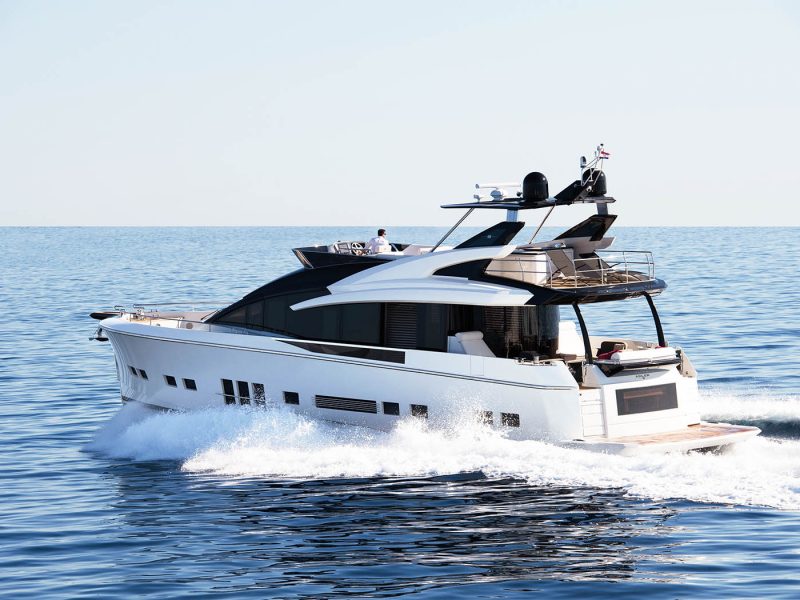
Si tratta di un 76 piedi, ovvero un’imbarcazione che ha una lunghezza fuori tutto che supera i 23 metri. Per raccontarla partiamo dai materiali. Carbonio e kevlar. Il risultato è uno scafo molto rigido ed efficiente allo stesso tempo. I pesi sono contenuti, tanto che a pieno carico arriva a 49 tonnellate. Non molte se consideriamo che ci sono tre ponti e tre paratie in sala macchine, una anticollisione, più altre due laterali. Leggera, ma allo stesso tempo solida e robusta. Bisogna garantire performance, ma anche sicurezza. È questo che si chiede a un progetto che nasce per il massimo comfort in navigazione. 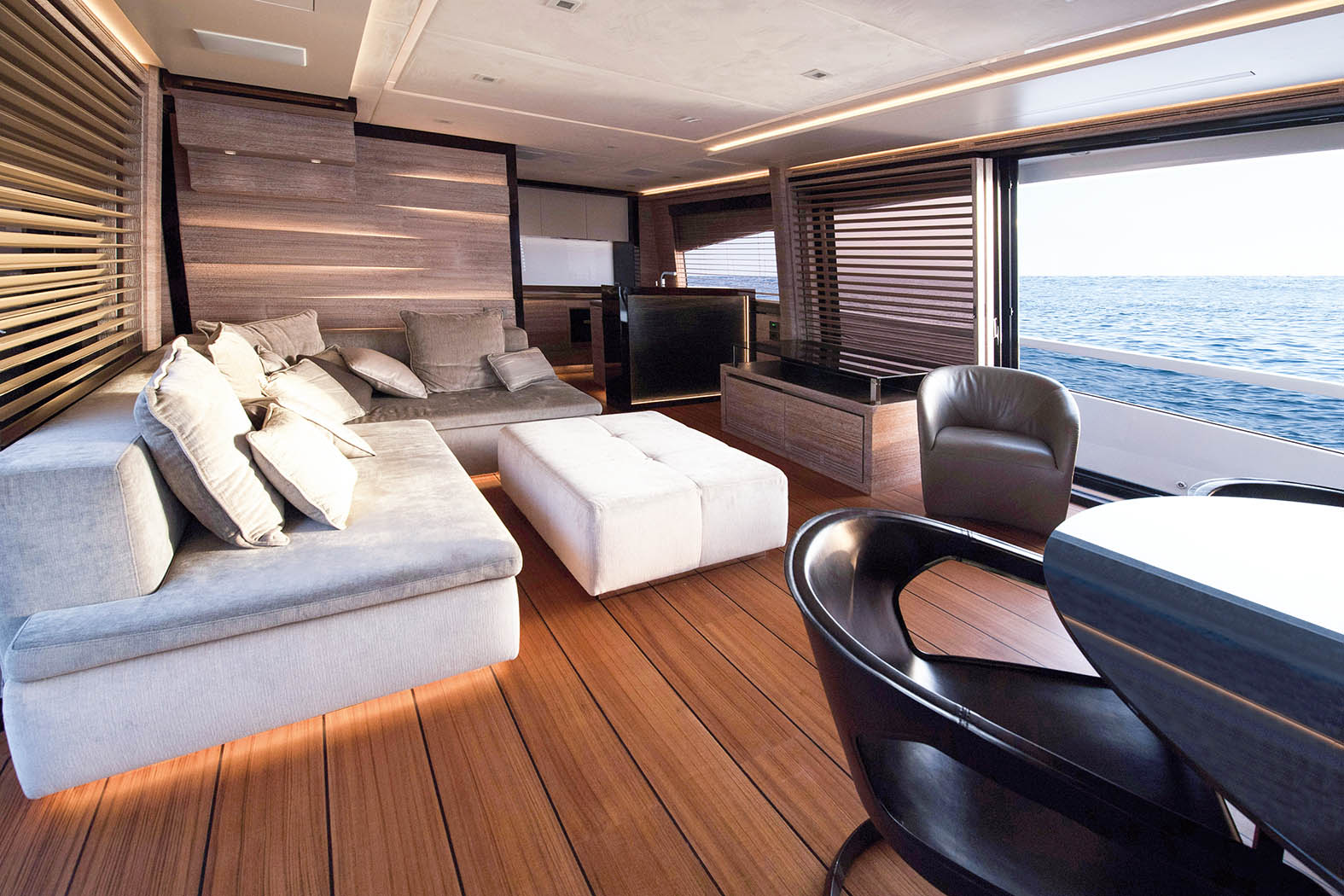
L’innovazione però non si ferma ai materiali. In sala macchine c’è una sorpresa. Oltre ai due motori Caterpillar da 857 kW (1150 cv) ciascuno, ci sono due unità elettriche ATE da 100 kW l’una e ben 2.2 tonnellate di batterie. La propulsione è ibrida e Adler l’ha chiamata HMS che è l’acronimo di Hybrid Marine Solution. Sistema nato dalla collaborazione tra TTControl, Aradex e Akasol aziende con una lunga esperienza sia in campo nautico, sia nel mondo dell’automotive. Quale è il vantaggio di una propulsione ibrida? Ai bassi regimi conviene navigare senza utilizzare i due Cat. E non lo diciamo per sentito dire o perché l’abbiamo letto da qualche parte. Abbiamo avuto modo di toccarlo con mano.
Quando molliamo gli ormeggi dal porto di Montecarlo, a bordo con noi c’è Alessandro Barizzi, Ceo di Adler Yacht. La prima sensazione è quella di navigare con una buona carena frutto di uno studio attento dove sono stati considerati perfettamente i pesi in relazione alle velocità che si vogliono ottenere. Certamente il lavoro fatto dallo Studio Nuvolari e Lenard, al Cfd e in vasca navale, ha stabilito in modo preciso il centro di gravità permettendo di capire a priori come si sarebbe mossa la barca in acqua. La forma dello scafo è a geometria variabile con un deadrise ridotto a poppa in grado di aumentare la portanza, migliorare l’efficienza e ridurre i consumi, con angoli più elevati a prua.
Questa scelta progettuale consente di migliorare la planata e renderla possibile a velocità più basse ottimizzando l’entrata nell’onda e rendendo più confortevole la navigazione con mare al traverso, al mascone o di prora. Durante la nostra prova ci siamo divertiti a navigare a tutte le andature con virate e controvirate continue. Siamo andati a cercare le onde di scia delle navi in transito e abbiamo provato le tre modalità di propulsione. Fino a 1100 giri, il motore elettrico è il più conveniente. Senza accendere gli endotermici si può arrivare fino a 8,5 nodi di velocità con un’autonomia di un’ora. La punta massima con questa modalità è di 10 nodi.
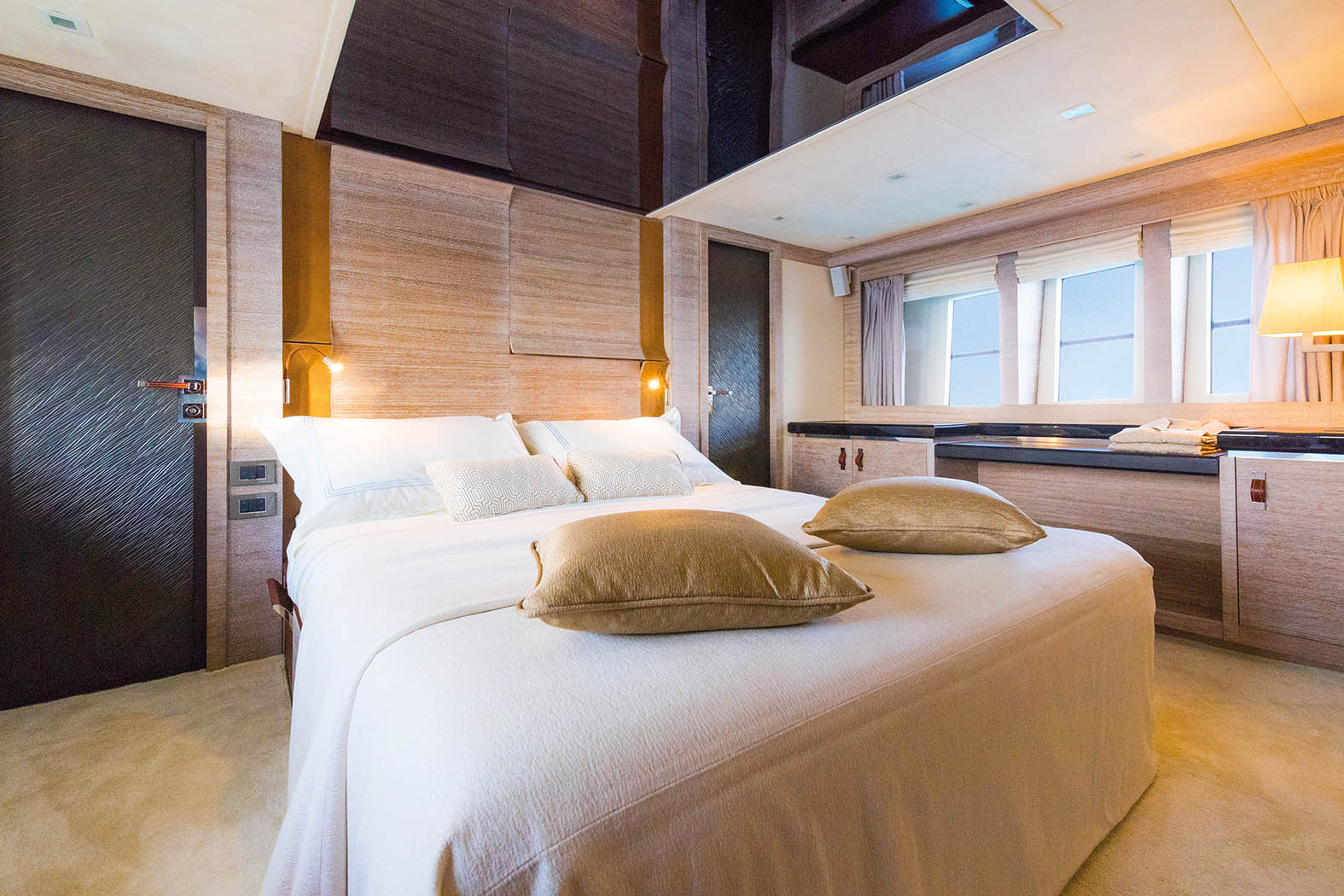 Il dato della rumorosità è ovviamente quello più sorprendente. Il fonometro registra valori compresi tra 55 e 59 dBA a seconda che ci si trovi nel salone, oppure nella cabina di prua. E sono tutti decibel piacevoli perché non si tratta del rumore provocato dalle vibrazioni del motore, ma dall’acqua che frange sulla prua durante la navigazione. Ai regimi intermedi, quelli compresi tra 1100 e 1800 giri, si può attivare il sistema ibrido. Anche in questo caso i numeri sono significativi. Si può navigare a poco meno di 20 nodi con un consumo decisamente moderato per un’imbarcazione di queste dimensioni e la rumorosità è quasi impercettibile. Non finisce qui.
Azionando i due CAT la spinta è notevole perché ci vogliono meno di dieci secondi per planare e anche la velocità è ragguardevole. Tra i 2000 e i 2370 giri si passa dai 21 ai 27,4 nodi. La ripresa è stata perentoria, ma graduale perché regolata dall’elettronica. Le accostate effettuate in velocità sono state precise e lo scafo ha risposto con immediatezza alla manovra del timone. La barca è maneggevole e i sei grandi schermi touchscreen di Furuno e Boening permettono di avere tutto sotto controllo: dati di navigazione, domotica, monitoraggio e controllo degli impianti.
Girando in tondo il raggio del cerchio è stato di circa 50 metri. Il comportamento sull’onda è stato ottimo la barca non picchia, ha un impatto morbido e non si sentono torsioni. Grazie a una riserva carburante di 5200 litri si ha anche una notevole autonomia che a 8.5 nodi arriva fino a 3500 miglia, niente male se consideriamo che la rotta Gibilterra, Canarie, Caraibi è di 3400 miglia.
Se poi la navigazione si limita al Mediterraneo, pensate a quanto raramente si dovrà fare sosta per il bunkeraggio. Dalle Baleari alla Sardegna le miglia sono 200. Questo significa che si può fare la rotta avanti e indietro otto volte con un pieno di gasolio. Poter scegliere come navigare e poter cambiare modo a seconda delle esigenze è certamente un elemento fondamentale per il comfort.
A hybrid propulsion, which is also soundless and with low fuel consumption. To guarantee style, Nuvolari and Lenard have been entrusted with both the interior and the hull design. The automation allows you to have everything under control, for a carefree sailing experience
When you are the last on the scene, you can’t simply copy the others. You can’t just do what the other people have already done. Adler is very aware of this, and that is why they have focused on innovation and technology. Five million euros have been invested in a project that began in 2012, which has elements in Switzerland, Austria, Germany and Italy. Ready, steady, go. And here we have a new yard and its first creation. It is a 76-footer, or a boat with an overall length exceeding 23 metres. To describe it, let’s start from the materials used. Carbon fibre and kevlar.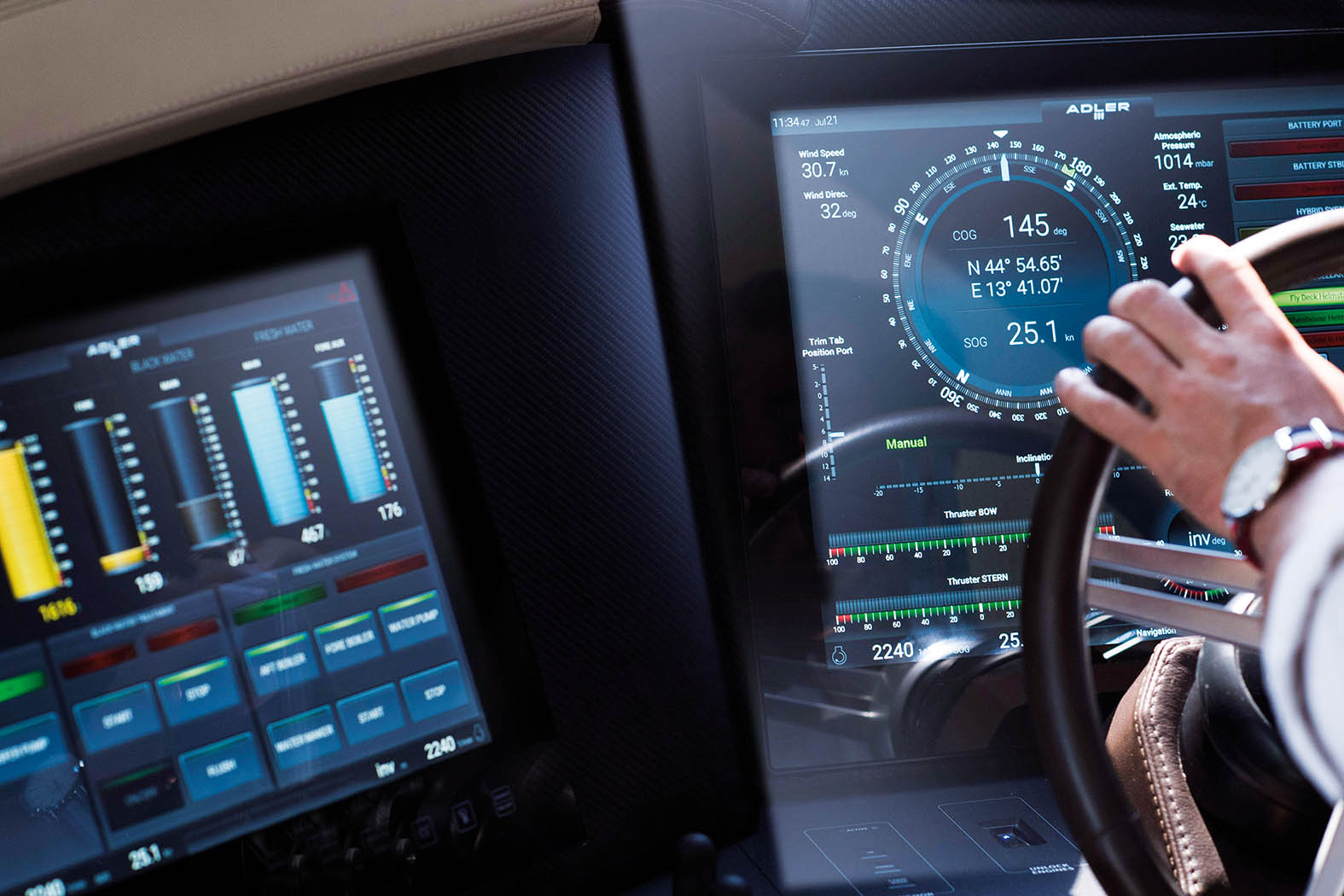
The outcome is a very stiff hull, which at the same time is very efficient. The weight is limited, so much so that when fully laden it is only 49 tonnes. That’s not a lot, considering that there are three decks and an anti-collision and two side bulkheads in the engine room. It is light, but at the same time solid and robust. You don’t just have to ensure performance, but also safety. That is what is required of a project that is focused on comfortable sailing.
But innovation does not stop at the materials. There’s a surprise in the engine room. In addition to twin Caterpillar engines of 857 kW (1150 hp) each, there are two ATE electrical units of 100 kW each and a 2.2 tonnes battery bank. Adler has named this hybrid propulsion HMS, which means Hybrid Marine Solution. It’s a system developed through the partnership of TTControl, Aradex and Akasol, which are very experienced companies in both the boating and automotive field. What is the advantage of a hybrid propulsion? It’s that, at low rotational speeds, you can navigate without using the twin Cat engines. And this is not hearsay, we have tested it.
When we slip our moorings at Montecarlo harbour, we have Alessandro Barizzi, the CEO of Adler Yacht with us. The first feeling when we take off is that the hull is good, and is the result of research to strike the right balance between weight and desired speed. Studio Nuvolari Lenard used CFD and a test tank to work out the precise location of the centre of gravity, which meant that they could know in advance how the boat would behave. The variable-geometry hull shape has a deadrise at the stern which can increase lift, improve efficiency and fuel consumption, and the bow is steeper. That design decision means that planing is improved and can be done at lower speeds, giving optimum wave entry, making it more comfortable in beam, and head seas.
During our test we had fun zig-zagging and continually changing speed. We went to look for bow waves from passing ships and tried out the three propulsion mode. Up to 1,100 rpm, the electric engine is the cheapest to use. You can do 8.5 knots and go for an hour without using the endothermic engines. The top speed like this is 10 knots. The noise level is clearly the most surprising thing about it. The equipment shows between 55 and 59 decibels, depending on whether you are in the lounge or the bow cabin. And these are all pleasant decibels, because it isn’t a noise caused by engine vibrations, but by the water breaking on the bow. In the intermediate range, between 1,100 and 1,800 rpm, the hybrid system can be activated.
There are some significant figures here too. You can go at less than 20 knots without using much fuel at all considering the size of the boat and the fact that it is scarcely audible. But that’s not all. You can feel the extra thrust when the two CAT engines cut in, because you need less than ten seconds to start planing and here too the speed is notable. Between 2,000 and 2,370 rpm you accelerate from 21 to 27.4 knots. It’s a commanding burst of power, but also a gradual one because it is electronically controlled. Maneuvering at speed is precise, and the boat responds immediately to the controls.
The boat is easily manoeuvrable and the six large Furuno and Boening touchscreens mean you can keep everything under control: sailing data, automated systems, monitoring and appliance checks. The turning circle is around 50 metres. It doesn’t climb the waves and behaves very well on them, the impact is soft and you don’t feel much twisting. With 5,200 litres in the tank, the range is also very good, and at 8.5 knots you can do 3,500 nautical miles, which is not bad if you think that the Gibraltar, Canaries, Caribbean route is 3,400 miles. If you limit yourself to the Mediterranean, you really don’t have to stop very much to refuel. From the Balearic Islands to Sardinia it is 200 miles. So you could go back and forth eight times without filling up. Being able to choose how to travel and changing mode according to requirements is certainly fundamental in terms of comfort.
PROGETTO Carlo Nuvolari e Dan Lenard (design interni e esterni)
SCAFO Lunghezza ft 23,11m • Larghezza massima 6,04m • Immersione 1,75m
• Dislocamento a vuoto 49000 kg • Capacità serbatoio carburante 5200 l
• Capacità serbatoio acqua 880 l • Capacità serbatoi acque nere e grigie 288 l
MOTORE 2 CAT C18 ACERT
• Potenza 857 kW (1150cv)
• Numero di cilindri 6 in linea • Alesaggio per corsa
145mm x 183mm
• Cilindrata 18,1 l
• Peso 1950 kg
• Regime di rotazione massimo 2300/min
PROPULSIONE ELETTRICA 2×100 kW ATE
CERTIFICAZIONE CE Categoria A
PREZZO € 3’900’000
PROJECT Carlo Nuvolari and Dan Lenard (interior and exterior design)
HULL LOA 23,11m
• Maximum Beam 6,04m
• Draft 1,75m • Light mass displacement 49000 kg
• Fuel tank volumes 5200 l
• Water tank volume 880 l
• Black and grey water tanks volume 288 l
MAIN PROPULSION
2 CAT C18 ACERT • Outlet mechanical power 857 kW (1150hp) • Number of cylinders 6 in line • Bore & Stroke 145mm X 183mm
• Totale swept volume 18.1 l • Weight 1950 kg • Maximal rotational speed 2300/min
ELECTRIC PROPULSION 2×100 kW ATE
CERTIFICATION EC
A Category
PRICE € 3’900’000
* con diesel + elettrico i consumi scendono a 208 l
//with the diesel electric mode the total consumption is of 208 l/h
ADLER INTERNATIONAL
BAARENSTRASSE, 10
CH-6304 ZUG
0041/792614148
www.adleryacht.com
(Luglio 2017)