Cura dimagrante
Suzuki è pronta per la prova bikini: 200 cv di potenza, 30 kg e 2 cilindri in meno. Abbiamo realizzato il test del motore sul Makò 68 e sul Cayman 23 Sport Touring
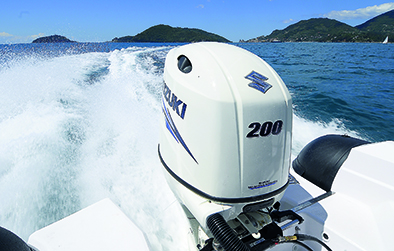
È UN PO’ COME SE FOSSE ANDATO IN PALESTRA. Aumenta la massa muscolare, diminuisce il grasso. Il protagonista è il nuovo Suzuki DF200 AP che per l’invidiabile forma non si è affidato a un personal trainer, bensì agli ingegneri giapponesi. L’obbiettivo della “dieta” era quello di ridurre il peso senza perdere potenza e per farlo sono stati tolti 2 cilindri. Il risultato sono 30 kg in meno, un motore più compatto e una nuova calandra per ottimizzare il sistema di raffreddamento con le prese d’aria collegate al circuito d’aspirazione. La cilindrata è notevole, ben 2.867 cc, e il rapporto di compressione è elevato, 10,2:1. Queste caratteristiche, unite al sistema di fasatura variabile VVT, consentono di ottenere molta accelerazione e tanta coppia già ai bassi e medi regimi. Il sistema Learn Burn, insieme al sensore di ossigeno, garantisce la necessaria miscela di benzina e ossigeno, offrendo così la performance migliore e una sensibile riduzione dei consumi. Il DF200 si presenta in due versioni: 200A e 200 AP. La differenza tra i due è che il modello AP possiede in dotazione anche Selective Rotation, Precison Control e Keyless Start System. Il primo permette di avere un motore controrotante cambiando solo un connettore sul cablaggio e l’elica. Il piede è lo stesso e gira destrorsa o sinistrorsa con la stessa efficacia. Precision Control è invece il sistema che elimina gli inconvenienti dovuti dagli attriti dei componenti meccanici. Il tutto si ottiene sempre grazie alla centralina elettronica da 32 bit. Questo sistema è stato progettato anche per evitare un uso improprio sull’invertitore. In pratica, anche se “picchiate” su marcia avanti, folle e retro come un fabbro sull’incudine, non riuscirete a fare molti danni perché le marce sono “ammortizzate”. Keyless Start System, infine, è il sistema di accensione a distanza che funge anche da antifurto. Finite le presentazioni di rito, non resta, come diceva il filosofo di Treviri, di verificare la teoria e prassi. Suzuki ci ha messo a disposizione il nuovo DF200AP installato su due diversi gommoni: Cayman 23 Sport Touring di Ranieri e Makò 68 di Zar Formenti. La prima cosa che colpisce è la silenziosità soprattutto al minimo. Non è una novità, in particolare per Suzuki che già una decina di anni fa aveva introdotto un sistema che impediva di “riaccendere” il motore. Questo perché al minimo era così silenzioso che c’era il rischio che qualcuno girasse ancora la chiave bruciando il motorino d’avviamento. Il nuovo 200 cv è ancora oltre. A 600 giri ha fatto registrare solo 58 dbA e la sensazione è che siano tutti dovuti ai 10/15 nodi di vento. La manetta elettronica è molto sensibile e francamente non si sente quasi per nulla lo scarto tipico delle elettroniche. L’erogazione della potenza è regolare. Il motore non ha “buchi” a nessun regime. Sorprendono i consumi perché sono davvero contenuti. Fino a 4000 giri sono addirittura di più i nodi dei litri/ora. Sul Cayman 23 a 4.000 giri si naviga a 25 nodi consumando 25 litri. Sul Makò 68, sempre a 4.000 giri, la velocità è di 27 nodi e i litri/ora meno di 26. Per verificare al meglio le performance, abbiamo provato a navigare a 20 e a 30 nodi con entrambi i battelli. A bordo del Makò 68 a 20 nodi il 200AP beve 15,3 litri, mentre sul Cayman 23 ne servono 16,9. A 30 nodi si passa dai 28 litri del gommone ZAR Formenti ai 34 di Ranieri. Con la manetta del gas tutta abbassata, su entrambi i battelli, il consumo è di soli 68 litri. E spinge pure bene, visto che alla massima il Gps ha registrato 43 e 46 nodi.
GALEOTTO FU IL CANOTTO
I test Suzuki a La Spezia ci hanno permesso di confrontare anche due battelli: Makò 68 e Cayman 23 Sport Touring. Le dimensioni sono simili visto che ballano 30 cm in lunghezza e 5 di larghezza. Simile anche il peso a secco con circa 60 kg di differenza. Il confronto tra le prestazioni è stato vinto al fotofinish dal modello ZAR Formenti. Per planare servono meno giri e meno velocità e alla massima naviga a 46 nodi, anziché 43 come il gommone di Ranieri. Molto vicine anche le prestazioni in accelerazione. Planano entrambi in 3 secondi e per raggiungere la massima ne impiega 19 il Makò e 22 il Cayman. Per contro, secondo il nostro personalissimo giudizio, il Cayman vince nell’allestimento della coperta. Gli spazi sono sfruttati meglio e tutto è ottimizzato. La seduta del pilota del Makò è un pò ingombrante e ostacola i movimenti nel pozzetto. Il Cayman offre una superficie maggiore come area prendisole a prua, un mobile grill cucina a poppavia della seduta del pilota e una plancia adeguata per ospitare display e plotter. Makò, invece, nonostante abbondi nella vetroresina un po’ ovunque, ne ha messa poca in plancia e non c’è lo spazio per mettere un plotter, nemmeno di piccole dimensioni. Pari nei volumi di stivaggio, mentre la prua ci è piaciuta di più quella del Makò 68. Il musone è molto ampio tanto che offre una superficie calpestabile 47×43 cm tra le due bitte. è decisamente comoda soprattutto se si ormeggia di prua in porto e se c’è una banchina piuttosto alta. Sul musone, infatti, si riesce a stare eretti con i due piedi affiancati.
Slimming
Suzuki is ready for the bikini test: 200 hp of power, 30 kg and 2 cylinders less. We have tested the engine fitted on the Makò 68 and on the Cayman 23 Sport Touring
IT’S A BIT LIKE IT’S BEEN GOING TO THE GYM. There’s more muscle, less fat. But if the enviable new Suzuki DF200 AP has not benefited from the expertise of a personal trainer, it certainly has of its Japanese engineers. The goal of its diet was to reduce weight without losing power, and to do this two cylinders were removed. The result is 30 kilos less, a more compact engine and a new grille to optimize the cooling system with the air vents connected to the suction circuit. The capacity is considerable, as much 2,867 cc, and the compression ratio is high at 10.2: 1. These characteristics, combined with the variable valve timing system, give a lot of acceleration and plenty of torque at low and medium engine speeds. The Lean Burn system, together with the oxygen sensor, ensures the right mix of fuel and oxygen for the best performance and a reduction in fuel consumption. There are actually two versions of the DF200, the 200 A and the 200 AP. The difference between the two is that the AP model also comes with Selective Rotation, Precision Control and a Keyless Start System. Selective Rotation allows you to have a counter-rotating motor just by changing prop and a wiring connector, with clockwise or anticlockwise rotation at the same effectiveness. Precision Control is a system that minimizes the friction of mechanical components, all thanks to a 32-bit electronic control unit, also designed to avoid improper use of the inverter. In practice, by smoothing out the gearing, it means that if you shove it into forward, neutral or reverse like a blacksmith on an anvil, you’re not going to do much damage. Finally, the Keyless Start System, is a remote ignition system that also prevents theft. Having attended to a cursory introduction, there remains, in the words of Marx, the theory and practice. Suzuki has made the new DF200AP available on two different dinghies: the Cayman 23 Sport Touring from Ranieri and the Makò 68 from Zar Formenti. The first thing that strikes you is how quietly it idles. This is nothing new, especially since ten years ago Suzuki had to introduce a system that, while idling silently, prevented someone trying to restart the motor and burn out the starter in the process. The new 200 hp is something more though. At 600 revs it gives out a mere 58 dBA and the perception that it’s all really down to 10-15 knots of wind. The electronic throttle is extremely sensitive and quite frankly doesn’t feel anything like the standard electronic fare, with the power delivery smooth and skip-less at all speeds. Fuel consumption is surprisingly efficient; even giving more knots up to 4000 rpm than it takes in litres per hour. Indeed, on the Cayman 23 at 4,000 rpm and 25 knots it consumes a bare 25 litres. And on the Makò 68, again at 4,000 rpm, and at 27 knots, consumption is less than 26 litres per hour. To better check the performance, we took both boats to 20 and 30 knots. Aboard the Makò 68 at 20 knots the 200AP drank 15.3 litres, while the Cayman 23 needed 16.9. At 30 knots, the ZAR Formenti took 28 litres and the Ranieri 34. With full throttle both boats had a consumption of only 68 litres yet decent thrust, with the GPS registering a maximum of 43 and 46 knots.
CUPID WAS THE CRAFT
The Suzuki tests at La Spezia also allowed us to compare the Makò 68 and Cayman 23 Sport Touring. Their dimensions vary only by 30 cm in length and 5 in width. Similarly, there is a difference of dry weight of only about 60 kilos. However, in terms of performance, the ZAR Formenti pulled ahead for the photo-finish, planing at lower revs and lower speed, and reaching a top of 46, compared to the Ranieri’s 43 knots. In acceleration they were much of a muchness, both planing within 3 seconds, and to reach maximum speed the Makò took 19 seconds and the Cayman took 22. By contrast, for us, the Cayman was the winner in deck furnishings. The overall space is better exploited and everything is optimized. The driver’s seat of the Makò, though, is a bit bulky and makes movement around the cockpit more cumbersome. The Cayman has a larger forward sundeck, a grill kitchenette aft of the driver’s seat and a console suitable for accommodating a display and plotter. The Makò, on the other hand, despite abounding in fibreglass, has placed little in the console and not made room even for a small plotter. There are equal volumes of storage in both, but we preferred the bow of the Makò 68, which offers a large walkable area of 47×43 cm between the two bollards, especially convenient when mooring up to a high dock since you’re able to stand upright with your feet side by side.
SUZUKI ITALIA DIVISIONE MOTORI MARINI
Corso Fratelli Kennedy 12, 10070 Robassomero (TO), tel. +39 011 9213711, www.suzuki.it
SUZUKI DF200 AP
DOHC 16 valvole • 4 cilindri in linea • Variable Valve Timing System • cilindrata 2.867 cc • potenza 200 cv (147 kW) • alesaggio per corsa 97×97 mm • regime di compressione 10.2:1 • rapporto al piede 2,5:1 • regime di rotazione massimo 5.800/6.000 giri/minuto • alimentazione Multi Point Sequenziale EFI • alternatore 12V – 44° • peso 228 kg (gambo lungo) e 233 kg (gambo extra lungo).
DOHC 16 valves • 4 cylinders in line • Variable Valve Timing System • displacement 2867 cc • max rated power 200 hp (147kW) • bore x stroke 97x97mm • compression ratio 10.2:1 • gear ratio 2.5:1 • RPM range 5800/6000 • EFI Sequential Multi Point ignition system • alternator 12V • 44° • Weight 228 kg (L steam engine) 233 kg (XL steam engine)
MOTONAUTICA FRATELLI RANIERI
loc. Caldarello, 88068 Soverato (CZ),
tel. +39 0967 25839,
www.ranieri-international.com
Scafo Lunghezza fuori tutto 7,10 m • baglio massimo 2,85 m • lunghezza interna 6,20 m • larghezza interna 1,59 m • diametro tubolari 0,60 m • materiale tubolari hypalon-neoprene Pennel & Flipo Orca da 1.670 dtex • 5 comportamenti • dislocamento a secco 700 kg • serbatoio carburante 200 litri • serbatoio acqua (optional) 45 litri • potenza massima installabile 250 cv (186 kW) • omologazione CE cat. B • portata 15 persone.
Hull: overall length 7.10m • max beam 2.85m • length 6.20m • beam 1.59m • tubes diameter 0.60m • tubes made of hypalon/neoprene Pennel & Flipo Orca of 1670 dtex • 5 compartments • dry displacement 700 kg • fuel tank capacity 200 l • water tank capacity (optional) 45 l • max rated power 250 hp (186 kW) • Certification CE cat B • max people on board 15.
ZAR FORMENTI
Località Vigna della Pace,
20086 Motta Visconti (MI) tel +39 02.90000788
fax +39 02.90001850 www.zar-formenti.com
Scafo Lunghezza fuori tutto 6,80 m • baglio massimo 2,80 m • lunghezza interna 5,90 m • larghezza interna 1,45 m • diametro tubolari 0,58 m • 5 compartimenti • dislocamento a secco 760 kg • potenza massima installabile 200 cv (148 kW) • omologazione CE cat. B • portata 12 persone.
Hull. Overall length 6.80m • max beam 2.80m • length 5.90m • beam 1.45m • tubes diameter 0.58m • 5 compartments • dry displacement 760 kg • max rated power 200 hp (148kW) • Ce certification cat B • max peolple on board 12.